

Brand mentions are quietly shaping how AI search engines like ChatGPT, Google AI Overviews, and Perplexity discover and recommend businesses. From editorial coverage to listicles, comparisons, reviews, and resource pages, every mention builds the trust signals AI models rely on. This complete playbook breaks down all seven brand-mention types, explains why they matter for AEO and GEO, and offers practical strategies to earn them. If you want lasting AI search visibility, this guide shows you exactly where to start.
1. Introduction: Why Brand Mentions Are Foundational to AI Search Visibility
Search has changed. People no longer rely only on ten blue links. They ask ChatGPT, Google AI Overviews, Perplexity, and other AI tools direct questions and expect direct answers. These tools do not pull information out of thin air. They pull it from content already available across the web, and brand mentions play a huge role in determining which brands are included in those answers.
A brand mention is simply any place online where your business, product, or name gets referenced, with or without a link. AI engines scan these mentions across blogs, news sites, forums, review platforms, and social channels to understand how often your brand comes up, in what context, and how trustworthy that context is.
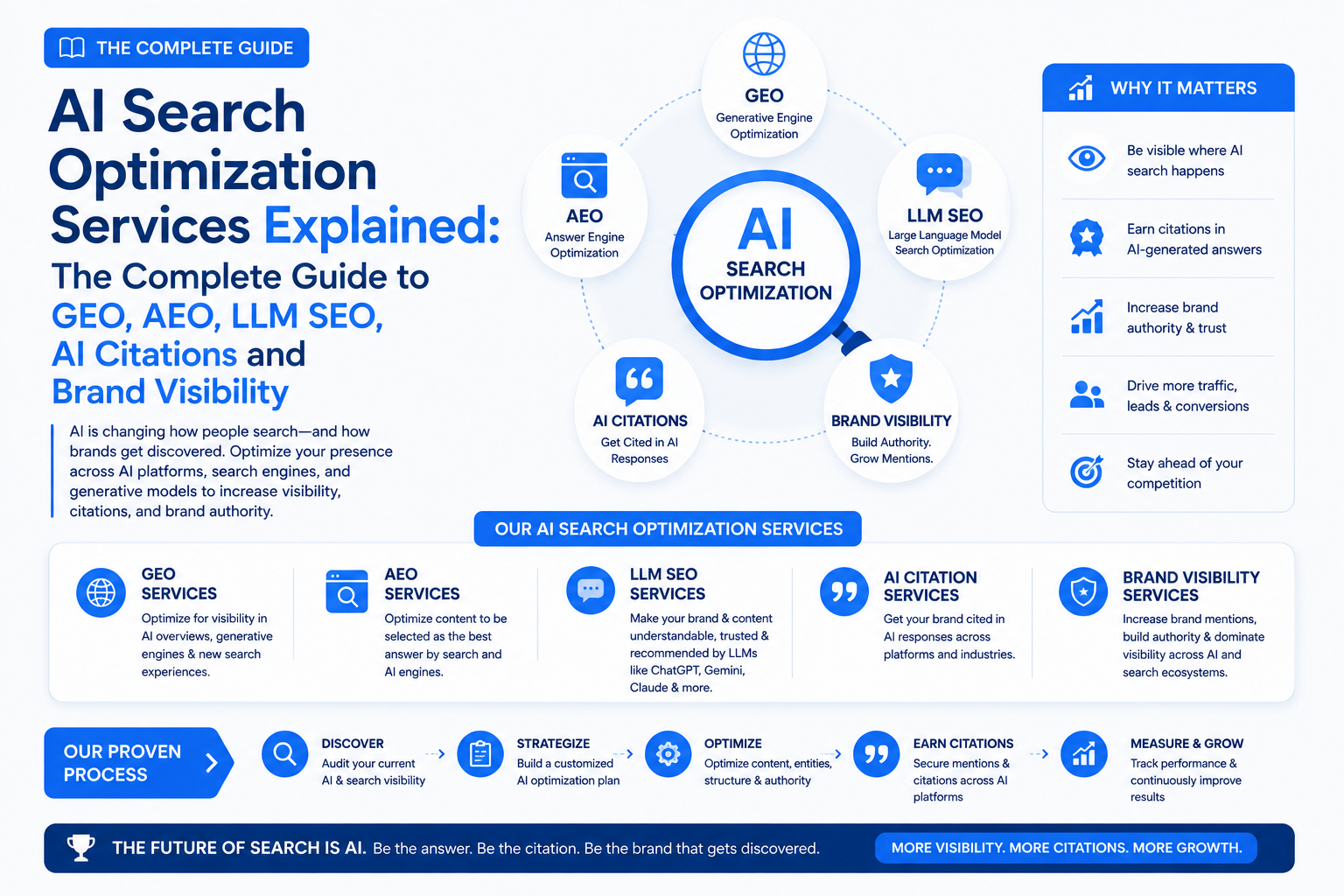
This guide breaks down the seven core types of brand mentions that influence AI search visibility, explains how each works, and outlines practical steps to earn them. Whether your goal sits under AEO, GEO, or general AI search optimization, the foundation is the same: get mentioned in the right places, in the right way, often enough that AI systems start to recognize your brand as a credible source. To establish your baseline and run systematic campaigns for these signals, you can reference our core AI search optimization services list to map your requirements.
2. What Are Brand Mentions and Why AI Search Platforms Rely on Them
2.1 Brand Mentions vs Backlinks: What Changed in AI Search
For years, backlinks were the gold standard. A link from a high-authority site told Google your content was worth ranking. Brand mentions matter differently in AI search.
AI models are trained on massive amounts of text and learn associations based on how often and consistently a brand name appears alongside certain topics, products, or problems. A mention without a link can still shape how an AI model perceives your brand because the model learns patterns of language and context, not just following clickable paths.
That said, links still help. A linked mention gives AI crawlers and retrieval systems a direct path to your site, helping them verify the mention and pull fresh details. The smartest approach treats mentions and backlinks as two sides of the same coin, not competing priorities.
2.2 How AI Engines Use Mentions as Trust and Relevance Signals
AI search tools need to answer questions accurately, and accuracy depends on trust. When an AI model sees your brand mentioned repeatedly across independent, reputable sources in similar contexts, it starts treating that pattern as a relevance signal.
Think of it like word of mouth at scale. If ten different industry blogs mention your software when discussing project management tools, an AI model learns to associate your brand with that category. The more consistent and widespread the mentions, the stronger that association becomes.
This is why diversity matters. A handful of mentions from unrelated, low-quality sites will not carry the same weight as fewer mentions from respected, topic-relevant sources. Quality and context shape how much trust an AI system assigns to each mention.
How AI Engines Use Mentions as Trust and Relevance Signals
Behind this process sits a technical layer called Named Entity Recognition, or NER. NER is how AI models identify your brand name within a sentence and treat it as a distinct entity, separate from the surrounding words. Once identified, the model uses sentiment analysis and natural language processing to connect that entity to nearby descriptive language, words like “affordable,” “reliable,” or “slow to respond.” This means a mention does not need a hyperlink to influence AI perception. A sentence that says your brand offers fast customer support teaches the model an attribute purely through language patterns, even on a page with zero links back to your site.
2.3 The Role of Mentions Across AEO, GEO, and Beyond
AEO, or Answer Engine Optimization, focuses on getting your content selected as the direct answer to a user’s question. GEO, or Generative Engine Optimization, focuses on how generative AI tools summarize, cite, and represent your brand in their responses.
Brand mentions sit underneath both. An answer engine pulling a featured snippet needs confidence that the source is credible, and mentions across the web build that credibility. A generative engine summarizing “best tools for X” draws on the collective mentions it has seen during training and through live retrieval.
Beyond AEO and GEO, mentions also influence voice search results, AI shopping assistants, and recommendation engines built into browsers and apps. The common thread is that AI systems are pattern-matching machines, and consistent brand mentions create the patterns they rely on.
The 7 Brand Mention Types at a Glance
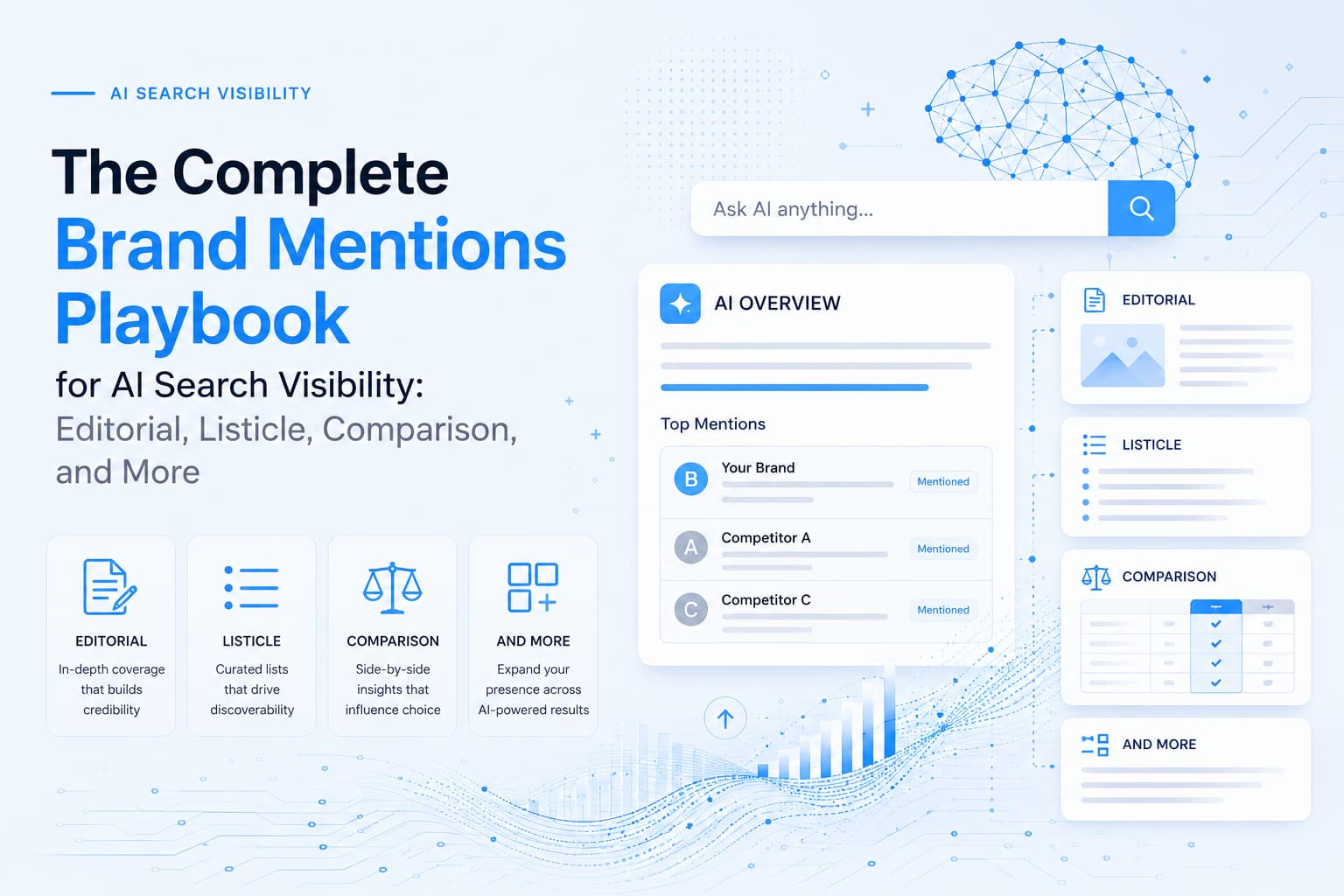
The 7 Brand Mention Types at a Glance
| Mention Type | Primary AI Signal | Difficulty to Earn | Long-Term Value |
|---|---|---|---|
| Editorial | Domain Trust & Authority | High | Very High |
| Listicle | Category Relevance | Medium | High |
| Comparison | Feature & Pricing Mapping | High | High |
| Industry Roundup | Topical Footprint | Low | Medium |
| Review | Sentiment & User Validation | Medium | Very High |
| Expert Contribution | E-E-A-T Credibility | High | High |
| Resource Page | Knowledge Graph Mapping | Medium | Long-Lasting |
3. Editorial Mentions
3.1 What Are Editorial Mentions
An editorial mention happens when a journalist, blogger, or content creator references your brand naturally within an article, usually because your product, service, or expertise adds value to the story they are telling. These mentions are not paid placements or sponsored content. They happen because your brand earned a spot in the narrative.
Editorial mentions carry significant weight because they come from independent third parties. When a respected industry publication covers emerging trends and cites your company as an example, it carries an implicit endorsement. AI models pick up on this independence, and it often translates into stronger trust signals than self-promotional content ever could.
These mentions can appear in news articles, trend pieces, feature stories, or in-depth analysis pieces. The key characteristic is that the writer chose to include your brand because it was relevant, not because they were asked to.
3.2 How to Earn Editorial Mentions
Earning editorial mentions starts with making your brand genuinely newsworthy or useful to journalists and writers covering your industry. Here are practical ways to do that:
- Publish original research, surveys, or data studies that journalists can cite as a source
- Build relationships with journalists and bloggers through platforms like HARO-style services or direct outreach
- Respond quickly and helpfully when reporters request comments or expert input
- Create a press page with clear information, quotes, and assets that make it easy for writers to reference you
- Develop a unique point of view on industry trends that gives writers a reason to quote your team
The common factor across all of these is value. Journalists mention brands that make their jobs easier, whether by providing data, a quote, or a fresh perspective on a familiar topic.
3.3 Why AI Engines Trust Editorial Content
Editorial content tends to come from established publications with editorial standards, fact-checking processes, and a reputation to protect. AI models trained on large datasets tend to give more weight to content from these sources because the information has typically undergone some level of verification.
When your brand appears in this type of content, it inherits some of that trust by association. A generative AI tool summarizing information about your industry is more likely to surface your brand if it has seen your name appear in credible, independent reporting rather than only in your own marketing materials.
This is also why editorial mentions tend to have a longer shelf life. News articles and feature pieces often remain indexed and referenced for years, which means a single strong editorial mention can continue to influence AI search results long after publication.
4. Listicle Mentions
4.1 What Are Listicle Mentions
Listicles are articles structured around lists, things like “10 Best Project Management Tools” or “7 Marketing Agencies Worth Following in 2026.” A listicle mention happens when your brand is included as one of the items in that list.
These mentions are incredibly common across blogs, review sites, and industry publications because list formats are easy to read and scan, and they tend to perform well in search. For AI search platforms, listicles are also useful because they present multiple options in a structured, comparable format, which makes them easier to summarize.
Listicle mentions often include a brief description of your brand, its key features, pricing, or what sets it apart. This context gives AI models a quick snapshot of how your brand fits within a category.
To see this in action, look at how large language models visually aggregate and map third-party listicles or comparison pages for end users. When an engine constructs an answer, it cross-references unlinked mentions and builds real-time recommendation cards. The visual mockup below illustrates exactly how a strategic mention feeds into a finalized AI search response:
Mockup examples showing how third-party listicle and comparison mentions power specific citations and brand recommendations across Google AI Overviews and Perplexity AI interfaces.
4.2 How to Get Featured in Listicles
Getting featured in listicles takes a mix of outreach, positioning, and sometimes patience. Consider these approaches:
- Search for existing listicles in your niche and reach out to the authors suggesting your brand as an addition
- Offer something useful in your pitch, such as a free trial, demo access, or unique data points the writer can use
- Build relationships with bloggers and review sites that regularly publish “best of” content in your category
- Create your own listicle-style content that naturally references your brand alongside competitors, which can sometimes get picked up or referenced by others
- Monitor when competitors get featured and pitch yourself for similar opportunities
Persistence matters here. Many listicle writers update their content periodically, so even if you do not make the cut initially, a follow-up months later with new information can lead to inclusion.
4.3 Why Listicles Are Frequently Cited by AI Overviews
AI Overviews and similar AI-generated summaries often favor listicle-style content because the structure mirrors how AI models like to present information, as organized, comparable options. When someone asks “what are the best tools for X,” an AI model trained on dozens of listicles covering that exact topic has a ready-made framework to draw from.
If your brand consistently appears across multiple listicles covering the same category, AI models begin to recognize it as a recurring, relevant option. This repetition across independent lists increases the likelihood that your brand will be included in an AI tool’s summary or recommendation.
Listicles also tend to use consistent language and formatting, which makes it easier for AI systems to extract structured information like pricing, features, and use cases directly from the mention.
5. Comparison Mentions
5.1 What Are Comparison Mentions
A comparison mention happens when your brand is referenced alongside competitors in content built specifically to compare options, such as “Brand A vs Brand B” articles or broader comparison guides covering multiple alternatives.
These mentions are valuable because they place your brand directly in the decision-making process. Someone reading a comparison article is typically close to making a choice, and AI search tools recognize comparison content as highly relevant for queries that include words like “vs,” “alternative,” or “compared to.”
Comparison mentions often include detailed breakdowns of pricing, features, pros, cons, and use cases, providing AI models with rich, structured information about how your brand stacks up against competitors in the same space.
5.2 How to Position Your Brand in Comparison Content
Getting included in comparison content and being positioned favorably requires a slightly different strategy than other mention types:
- Identify which competitors are most frequently compared to your brand and create your own comparison content that includes your product alongside them
- Reach out to review sites and bloggers who write comparison content and offer detailed, accurate information about your product to ensure fair representation
- Keep your own website’s comparison or “alternatives” pages updated, since these often get referenced or linked by third-party comparison content
- Highlight specific differentiators clearly on your site, such as pricing, unique features, or customer support quality, so writers have accurate details to work with
- Monitor existing comparison articles for outdated or inaccurate information about your brand and politely request corrections
Accuracy matters enormously here. If a comparison article contains outdated pricing or missing features, it can hurt how AI models represent your brand, so keeping information current across the web is part of an ongoing strategy.
5.3 Why AI Tools Favor Comparison Formats
Comparison queries are some of the most common in AI search. People ask things like “what is the difference between X and Y,” or “which is better for small businesses.” AI models need source material that directly addresses these side-by-side questions, and comparison content is built exactly for that purpose.
When an AI tool generates a comparison response, it often draws from multiple comparison articles to build a balanced answer. If your brand appears consistently across these comparisons and provides accurate, detailed information, it increases the chances of being included in AI-generated comparison summaries.
This format also tends to surface specific attributes, pricing tiers, feature lists, target audiences, which gives AI models concrete data points to reference rather than vague descriptions.
6. Industry Roundups
6.1 What Are Industry Roundups
Industry roundups are articles or newsletters that compile multiple resources, tools, news items, or expert opinions related to a specific topic or time period. Examples include “Top Marketing Trends This Month” or “Best Resources for Learning SEO in 2026.”
A roundup mention happens when your brand, content, or commentary gets included in one of these compilations. Unlike listicles, which often focus on products, roundups frequently cover a mix of content types, including articles, tools, expert quotes, and news.
These mentions help establish your brand as part of the broader conversation happening in your industry, which AI models pick up on when assessing topical relevance and authority.
6.2 How to Get Included in Roundups
Roundups are typically published on a recurring schedule, weekly, monthly, or quarterly, which creates regular opportunities for inclusion:
- Identify recurring roundup content in your industry and subscribe to understand their format and selection criteria
- Submit your best content directly to roundup curators when they open submissions, which many do through simple forms or email
- Produce timely, high-quality content around trending topics, since roundups often favor recent, relevant pieces
- Engage with roundup creators on social media, since many curators discover content through their own networks
- Build a reputation for consistently useful content, which increases the likelihood of being proactively included without outreach
Consistency pays off here. Brands that regularly produce valuable content tend to become recurring names in industry roundups over time.
6.3 Building Topical Authority Through Roundups
Topical authority refers to how strongly an AI model or search engine associates your brand with a specific subject area. Industry roundups contribute to this by repeatedly placing your brand within the context of a particular topic, alongside other recognized names in that space.
When your brand appears in roundup after roundup focused on, say, content marketing or cybersecurity, AI models start to build a stronger association between your brand and that subject. This association can influence how often your brand gets referenced when someone asks an AI tool a question related to that topic.
Roundups also tend to link back to original sources, which means each inclusion can drive both direct traffic and reinforce the web of mentions that AI systems use to map relevance.
7. Review Mentions
7.1 What Are Review Mentions
Review mentions come from platforms where users or experts evaluate products and services, such as G2, Capterra, Trustpilot, Google Reviews, or industry-specific review sites. These mentions include both your brand’s overall presence on the platform and the content of the reviews themselves.
Unlike editorial or listicle mentions, review mentions are often generated by real customers, which gives them a different kind of credibility. AI models trained on this data can pick up on sentiment, common praise points, recurring complaints, and overall reputation.
Review platforms also tend to offer structured data, ratings, categories, and comparison features that make it easier for AI systems to extract and summarize information about your brand’s market standing.
7.2 Review Platforms That Influence AI Search Results
Different industries rely on different review platforms, but some have broad influence across AI search:
- G2 and Capterra are heavily referenced for software and SaaS products, often appearing in AI-generated software comparisons
- Trustpilot and Google Reviews carry weight for general business reputation and local search visibility
- Industry-specific platforms, such as Healthgrades for healthcare or Avvo for legal services, influence niche AI search results
- App store reviews on Google Play and the Apple App Store matter significantly for mobile app visibility in AI assistants
- Reddit and niche community forums, while not traditional review platforms, function similarly when users discuss and recommend products
AI models often treat these platforms as aggregated sources of sentiment, pulling overall ratings and common themes rather than individual review text.
7.3 Encouraging and Managing Customer Reviews
A steady stream of genuine, recent reviews signals to both users and AI systems that your brand is active and relevant. Here is how to build that consistently:
- Ask satisfied customers for reviews at natural moments, such as after a successful support interaction or milestone
- Make the review process simple by providing direct links to your profiles on relevant platforms
- Respond to reviews, both positive and negative, since active engagement signals a brand that cares about its reputation
- Address negative feedback constructively, since AI models analyzing sentiment will pick up on how issues are resolved, not just that they occurred
- Avoid fake or incentivized reviews, since platforms increasingly detect and penalize these, which can damage trust signals rather than build them
Authentic engagement with reviews over time builds a reputation that AI systems can confidently reference when summarizing how customers feel about your brand.
8. Expert Contribution Mentions
8.1 What Are Expert Contribution Mentions
Expert contribution mentions happen when someone from your team, often a founder, executive, or subject matter expert, contributes insights, quotes, or full articles to external publications. This includes guest posts, expert roundup quotes, podcast appearances, and contributed columns.
These mentions differ from editorial mentions because they are typically initiated by your side; you or your team are actively providing the expertise, rather than being written about by a third party. However, they still carry strong credibility because a reputable publication chose to feature your expert’s perspective.
This type of mention directly supports the “Expertise” and “Authoritativeness” components of E-E-A-T, since it demonstrates that recognized platforms consider your team knowledgeable enough to feature.
8.2 How to Secure Expert Contribution Opportunities
Building a presence as a go-to expert takes deliberate effort:
- Identify publications and platforms in your industry that accept guest contributions or expert commentary
- Pitch specific, well-developed article ideas rather than vague offers to “write something.”
- Sign up for journalist query platforms where reporters look for expert sources on specific topics
- Pursue podcast guest appearances in your niche, since these often come with show notes and links that count as mentions
- Build a track record by starting with smaller, niche publications before pitching larger, more competitive outlets
The goal is to position someone on your team as a recognizable voice within your industry, someone journalists and editors think of when they need an expert opinion.
8.3 Strengthening E-E-A-T Through Contributions
E-E-A-T, standing for Experience, Expertise, Authoritativeness, and Trustworthiness, has become central to how both traditional search and AI search evaluate content quality. Expert contribution mentions directly feed into this framework.
When your team’s insights appear across multiple respected platforms, it builds a body of evidence that AI models can draw on to assess whether your brand represents a credible source of information in its field. A single guest post helps, but a pattern of contributions across different publications and platforms that cover related topics builds a much stronger signal.
This is particularly important for AI search because generative tools often need to attribute information to a source when answering questions. Brands with a visible track record of expert contributions are more likely to be candidates for that attribution.
9. Resource Page Mentions
9.1 What Are Resource Page Mentions
Resource pages are curated lists of helpful links, tools, guides, or references that website owners maintain for their audience. A resource page mention occurs when your website, tool, or content is included on one of these pages, often under categories such as “Useful Tools,” “Recommended Reading,” or “Helpful Resources.”
Unlike time-sensitive content like news articles or listicles, resource pages tend to be evergreen. Once your brand is added, it often stays there for years unless the page owner does a major overhaul.
These mentions are valuable because they typically come from sites that maintain them as a service to their audience, which means inclusion often signals genuine usefulness rather than promotional placement.
9.2 How to Find and Pitch Resource Pages
Finding relevant resource pages takes some targeted searching, but the payoff can be long-lasting:
- Search for phrases like “resources,” “useful links,” or “recommended tools” combined with your industry keywords to find existing pages
- Look at competitor backlink profiles to identify resource pages that already link to similar businesses
- Reach out to page owners with a brief, specific pitch explaining why your resource fits their existing list
- Offer something genuinely useful, such as a free tool, comprehensive guide, or template, since resource pages favor practical value over promotional content
- Check back periodically, since some resource pages get updated and may remove outdated links, creating opportunities for fresh additions
The pitch should focus on value to the page’s audience, not on what your brand gains. Page owners are more responsive when the addition clearly helps their visitors.
9.3 Long-Term Value for SEO and AI Visibility
Resource page mentions tend to compound in value over time. Because these pages are often linked to from multiple sources and remain stable for years, the mentions they contain become part of a consistent, long-term signal that AI models can rely on.
For AI search specifically, resource pages are often crawled and referenced repeatedly, so a single well-placed mention can continue to contribute to your brand’s visibility long after the initial placement. This makes resource page outreach one of the more efficient long-term investments in a brand-mention strategy, since the effort required is often a single pitch, but the payoff continues for years.
10. Building a Brand Mention Strategy for AI Search Platforms
10.1 Identifying High-Impact Platforms and Sources
Not all mentions carry equal weight, so the first step in any strategy is identifying where your effort will have the most impact. Start by researching where your competitors are getting mentioned, since these platforms have already shown a willingness to cover your industry.
Look specifically for sites that AI models frequently cite, such as well-established industry publications, popular review platforms, and resource pages with a strong domain history. Tools that track brand mentions and backlinks can help identify patterns in where your industry’s conversation is happening.
Prioritize platforms based on relevance to your specific niche, audience overlap, and how frequently that platform’s content appears to influence AI-generated answers in your category.
10.2 Outreach and Relationship Building Tactics
Sustainable mention building relies on relationships, not one-off requests. Some practical tactics include:
- Engage genuinely with journalists, bloggers, and creators on social media before making any direct ask
- Offer exclusive data, early access, or unique insights that give the other party a reason to want to work with you
- Follow up respectfully if you do not hear back, since many positive responses come from a second or third touch
- Maintain a simple tracking system for outreach efforts, including who you contacted, when, and the outcome
- Treat every successful mention as the start of a relationship, not a one time transaction, and look for ways to provide value again in the future
Relationships built over time often lead to repeated mentions, faster responses, and even unsolicited coverage as contacts think of your brand when relevant opportunities arise.
10.3 Tracking, Measuring, and Scaling: Mention Impact
Once mentions start coming in, tracking their impact helps refine your strategy over time. Useful approaches include:
- Set up brand mention alerts using tools that monitor the web for new mentions of your brand name
- Track which types of mentions correlate with increases in branded search volume or AI search visibility
- Monitor how AI tools like ChatGPT, Perplexity, or Google AI Overviews represent your brand when asked relevant questions, checking periodically for changes
- Identify which mention types and sources produce the strongest results, then double down on similar opportunities
- Document successful pitches and outreach templates so the process can be repeated and scaled across your team
Over time, this data helps you understand not just whether mentions are occurring, but whether they translate into actual visibility improvements in AI search results.
10.4 Using Schema Markup to Reinforce Your Mentions
Brand mentions tell AI models what others say about you. Schema markup tells AI models what you say about yourself, in a format machines can verify directly. Implementing the Organization, Product, and Review schema on your own website gives AI systems a structured, authoritative source to cross-check mentions they find elsewhere on the web.
When a third-party listicle or comparison article mentions your pricing or features, accurate schema on your own site acts as the source of truth AI models can validate that mention against. Mismatches between what’s mentioned externally and what your schema states can weaken trust signals, so keeping schema data current is part of an effective mention strategy rather than a separate technical task.
Practical steps:
- Add an organization schema with your official name, logo, and social profiles to help AI models confirm entity identity
- Use the Product or Service schema to keep pricing and feature data accurate and machine-readable
- Implement the Review or AggregateRating schema to reinforce sentiment signals already building up through review mentions
- Update the schema whenever pricing, features, or company details change, since outdated structured data can contradict newer mentions found elsewhere. For technical assistance setting up these cross-checks, view the entry requirements outlined on our AI search optimization services list.
11. Common Mistakes to Avoid When Building Brand Mentions
Several missteps can undermine an otherwise solid brand mention strategy:
- Focusing only on link building while ignoring unlinked mentions, which still carry weight for AI models
- Pursuing low-quality or irrelevant placements just to increase mention volume, which can dilute trust signals
- Letting outdated information persist across comparison pages, review profiles, or resource pages creates inconsistency that AI models may pick up on
- Treating outreach as a one-time campaign rather than an ongoing relationship-building effort
- Ignoring negative reviews or mentions, which can shape sentiment analysis used by AI systems
- Overusing brand name repetition in ways that feel unnatural or promotional, which can come across poorly in both human and AI-generated content
- Failing to monitor how your brand is currently represented in AI search results, missing opportunities to correct or improve existing perceptions
Avoiding these pitfalls often matters as much as actively pursuing new mentions, since consistency and accuracy underpin the extent to which AI models trust any given signal.
12. Conclusion: Turning Brand Mentions into Long-Term AI Search Authority
Brand mentions are not a quick fix, but they are one of the most durable ways to build visibility in an AI-driven search landscape. Editorial coverage, listicles, comparisons, roundups, reviews, expert contributions, and resource pages each play a distinct role in shaping how AI models perceive and represent your brand.
The brands that succeed here are the ones that treat mentions as part of a long-term reputation-building process, not as a one-off checklist. Consistency across multiple mention types, paired with accuracy and genuine value, creates the kind of pattern that AI search platforms recognize and trust.
Start with one or two mention types that feel most achievable given your current resources, build momentum, and expand from there. Over time, these efforts compound, creating a web of signals that helps your brand show up exactly where your audience is looking, even when that audience is asking an AI assistant instead of typing into a search bar.
FAQs About Brand Mentions
What is the difference between a brand mention and a backlink?
A backlink is a clickable link pointing to your website, while a brand mention is any reference to your brand name, with or without a link. Both matter for AI search, but mentions can influence brand perception even without driving direct traffic.
Do unlinked brand mentions help SEO and AI search visibility?
Yes. AI models learn associations from patterns in text, so a brand mentioned consistently in relevant contexts builds recognition even without a direct link. Linked mentions add verification and crawl access, but unlinked mentions still contribute to overall signal strength.
How long does it take to see results from a brand mention strategy?
Results vary, but most brands start noticing changes in visibility and recognition within a few months of consistent effort. Resource pages and editorial mentions tend to have a longer-lasting impact, while listicle and roundup mentions may show effects more quickly due to frequent content updates.
Which type of brand mention is most important for AI search?
There is no single most important type. AI search platforms value diversity and consistency across multiple mention types. A combination of editorial coverage, reviews, and comparison mentions tends to build the strongest overall trust signal.
Can negative reviews hurt my brand’s visibility in AI search?
Negative reviews alone do not necessarily hurt visibility, but unaddressed patterns of complaints can affect sentiment analysis. Responding constructively to negative feedback often matters more than the negative review itself.
How can I check how AI tools currently describe my brand?
You can ask AI tools like ChatGPT, Perplexity, or Google AI Overviews direct questions about your brand, products, or industry category to see how your brand is represented. Doing this periodically helps you spot inaccuracies or gaps you can address through targeted mention building.
1
Leave a Comment