

AI search is reshaping how content gets discovered, and citations are the new currency of visibility. This guide breaks down 35+ proven ranking factors that decide whether ChatGPT, Perplexity, Gemini, and Google AI Overviews cite your content or skip it. From crawlability and fan-out queries to entity trust, structured data, and original research, you’ll learn exactly what works in 2026. Audit your content, fix the gaps, and start earning citations that drive real traffic.
AI Citation Ranking Factors: The Complete Guide to Getting Cited by ChatGPT, Perplexity, Gemini, and Google AI Overviews
AI search has rewritten the rules of online visibility. Where ten blue links once decided who got traffic, AI engines now read the web, pick a handful of sources, and stitch together a single answer. If your page is one of those sources, you get a citation, a clickable link, and a real shot at qualified traffic. If it isn’t, you might as well not exist for that query.
The good news: AI citations aren’t random. After reviewing the published studies, patents, and field experiments from the last two years, clear patterns emerge. Some factors mirror traditional SEO. Others are genuinely new. This guide groups them into seven practical themes so you can audit your own content and fix the gaps that matter most.
A quick note before we dive in. These aren’t ranking factors in the formal Google-algorithm sense. They’re features consistently correlated with citations across multiple studies. Correlation isn’t causation, but when independent experiments point in the same direction, the signal is worth listening to.
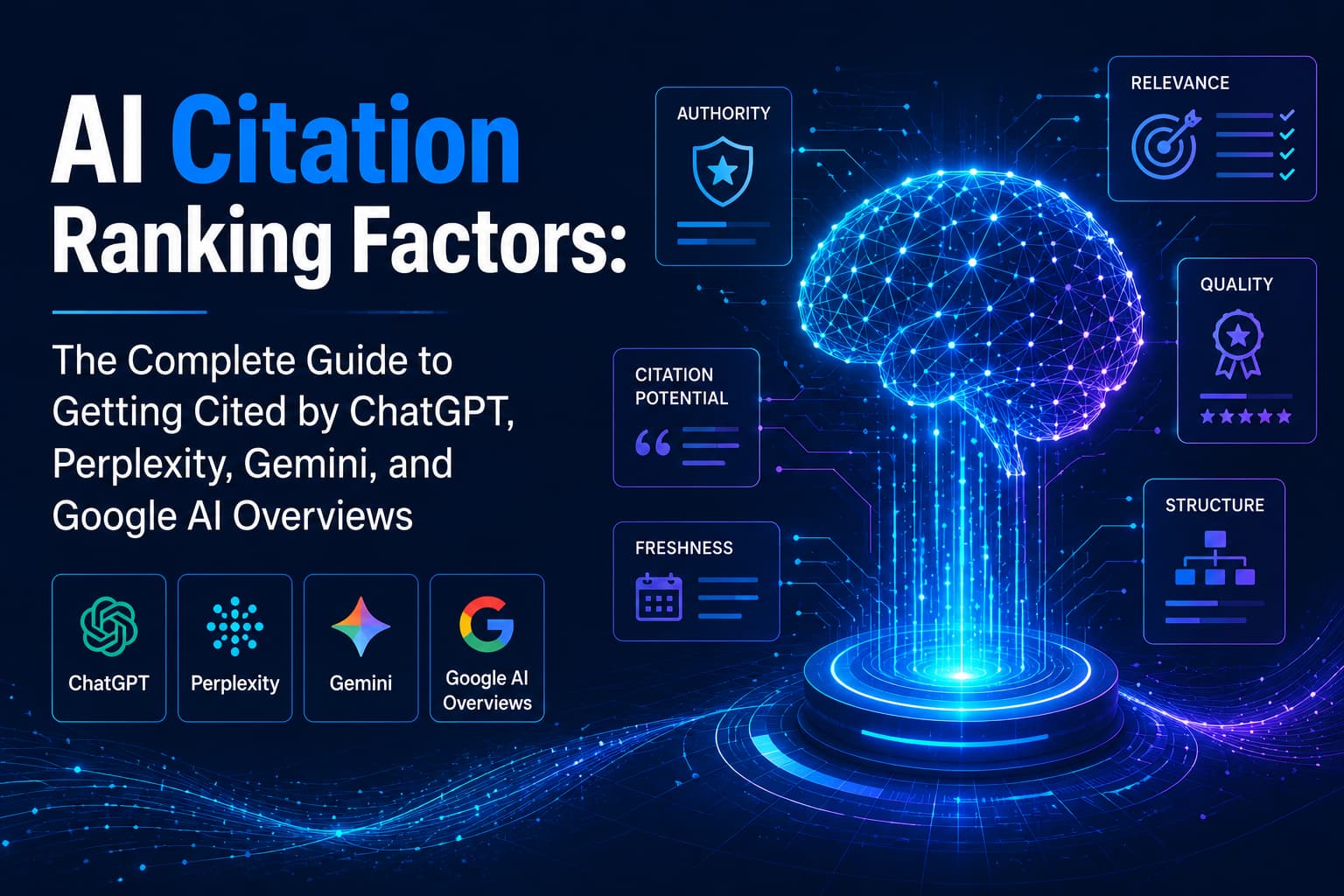
The Complete Guide to Getting Cited by ChatGPT, Perplexity, Gemini, and Google AI Overviews
Theme 1: Crawlability and Technical Access
Before anything else can matter, an AI engine has to actually reach your page. This is where a surprising number of sites quietly disqualify themselves without realizing it.
URL Accessibility
If a bot can’t fetch your URL, nothing else on this list helps. Pages need to return a clean 200 status code, load without authentication walls, and remain reachable during both training crawls and real-time grounding. The wrinkle in 2026 is that “accessible” now means accessible to a dozen different user agents, each operated by a different AI company. Audit your server logs to confirm AI crawlers are actually reaching your important URLs.
Preview Control Directives
The nosnippet and data-nosnippet Tags tell Google and Bing how much of your text they can show. Used carelessly, they can suppress the exact passages an AI engine wants to cite. If a section of your page is your best answer to a query, don’t wrap it in directives that hide it from preview surfaces. Review every page-level meta robots tag and every inline data-nosnippet attribute on your top-performing content.
Content Visibility
Content tucked behind tabs, accordions, or “read more” toggles tends to be weighted less than content visible by default. AI engines, like Google before them, seem to trust what’s plainly visible over what’s hidden. If a fact is important, put it in the open where both humans and crawlers can see it without interaction.
LLMs.txt
There’s no credible evidence yet that LLMs.txt files influence citations. The standard exists, a few sites use it, but no published experiment has shown it moves the needle. Implement it if you want to be ready for future adoption, but don’t expect results today. It belongs on your roadmap, not your priority list.
AI Bot Allowlisting
This is the one most sites get wrong without realizing it. Cloudflare, default WAF rules, and aggressive bot management often block GPTBot, ClaudeBot, PerplexityBot, OAI-SearchBot, and Google-Extended without anyone noticing. Check your robots.txt and your edge configuration. There’s a strategic question about whether you want training-data bots in, but blocking the real-time search bots is almost always a mistake if citations are your goal.
Render Path
Most AI crawlers don’t execute JavaScript the way Googlebot does. Content that only appears after client-side hydration is often invisible to them. Server-side rendering, static generation, or pre-rendering for bots is no longer optional. Test your important pages by viewing the raw HTML response rather than the rendered DOM. If your key facts aren’t in the initial HTML, fix it.
Page Speed and Time to First Byte
When an AI engine runs a live grounding search, it has a retrieval budget. Slow servers get dropped. A page with a five-second TTFB simply won’t make it into the response window for Perplexity or AI Overviews. Treat speed as a citation factor, not just a UX one. Aim for a TTFB under one second on your priority pages.
Theme 2: Ranking and Retrieval Signals
Once your page is reachable, the next question is whether AI engines actually retrieve it during their search step.
Search Rank
The overlap between Google’s top results and AI citations is undeniable. Studies consistently show a meaningful share of AI Overview citations come from the top ten organic results. The exact percentage is shifting as AI engines develop their own preferences, but ranking well on Google remains one of the strongest predictors of getting cited in AI answers, especially on Google’s own surfaces. Traditional SEO is still the foundation.
Fan-Out Rank
Here’s where AI search diverges from traditional search. When you ask an AI a question, it doesn’t run one search. It decomposes the question into multiple sub-queries — the “fan-out” — and searches each one. A query about “best running shoes for flat feet” might generate sub-queries for “overpronation shoes,” “stability shoes 2026,” and “arch support footwear.” If you rank for those fan-out queries, you get pulled into the answer even if you don’t rank for the main one.
Topic Cluster Ranking
The more sub-queries you rank for inside a topic, the higher your odds of being cited at least once. This rewards genuine topical depth: cover the parent topic and all its branches with linked, related pages. A single great article gets cited occasionally. A well-built cluster of fifteen related articles gets cited repeatedly across the same answer.
Domain Authority
Link signals still carry weight, just less than they used to. Several studies find a weak but consistent relationship between domain authority metrics and citation frequency. Don’t build your strategy around link-chasing, but don’t dismiss links either. They feed into the broader set of trust signals that AI engines rely on when choosing among similar candidate pages.
Multi-Engine Index Presence
Bing’s index powers ChatGPT search and Copilot. Google’s index powers Gemini and AI Overviews. Most SEO teams obsess over Google and ignore Bing, then wonder why they’re invisible in ChatGPT. Submit your sitemap to Bing Webmaster Tools and verify your indexing there. It’s a five-minute fix with outsized returns.
Theme 3: Relevance and Query Matching
Retrieval gets you into the candidate pool. Relevance decides whether you’re picked from it.
Query-Answer Match
AI engines look for tight semantic alignment between the user’s question, the AI’s draft answer, and the cited source. The closer your page’s wording matches the language of the query and the framing of the answer, the more likely you are to be selected. This isn’t keyword stuffing. It’s writing about the topic in the same natural language people actually use to ask about it.
Intent-Format Match
Format follows intent. “Best” queries get listicles and comparison tables. “How to” queries get step-by-step guides. “What is” queries get definition-led explainers. If your content format doesn’t match the query intent, you’re at a structural disadvantage regardless of how good the writing is. Audit your top target queries and check whether your page type fits what the query is actually asking for.
Language
AI engines are biased toward content in the same language as the query, and often the same region. A French query from Paris is far more likely to return French sources. If you operate in multiple markets, properly localized content — not machine-translated filler, not English-only — is a citation lever, not just a usability one.
Question-Phrased Headings
H2 and h2 headings written as natural questions (“How does compound interest work?”) consistently outperform keyword-style headings (“Compound Interest Basics”) for AI visibility. AI engines look for question-answer pairs they can lift directly. Make their job easy by phrasing your subheads the way users phrase their queries.
Conversational Query Alignment
AI search queries are dramatically longer than Google queries. The average ChatGPT prompt runs around twenty-three words, compared to under five for a typical Google search. People type to AI the way they talk. Content written in natural, conversational language gets retrieved more often for these longer queries than content optimized only for short-tail keywords.
Theme 4: Content Extractability and Structure
Here’s a critical insight from the research: AI engines rarely retrieve your entire page. They break it into passages and pull specific chunks. The structure of your content determines what gets pulled.
Answer Near the Top
Important content placed in the upper half of the page gets retrieved more reliably. Google’s Gemini reportedly applies a strict retrieval cap per URL, meaning only a limited slice of your content is considered. Front-load your most citable facts. Don’t bury the answer under three paragraphs of context-setting.
AI-Ready Structure
Clear headings, short sections, logical hierarchy, scannable formatting. Pages that look organized to a human reader look organized to a retrieval system. You don’t need to chop everything into micro-chunks, but you do need obvious section breaks, descriptive subheads, and a structure that telegraphs what’s where.
Self-Contained Passages
Each section should make sense on its own. If a paragraph says “this approach works better” but never specifies what approach or what it works better than, an AI engine retrieving just that paragraph has no usable claim to cite. Write as if every paragraph might be pulled in isolation, because some of them will be.
Length
Longer content tends to be cited more often, but the relationship isn’t linear. Beyond a certain point, length starts working against you because AI engines won’t retrieve all of it anyway. Cover the topic completely, then stop. Don’t pad for word count, and don’t truncate either. Let the topic dictate the length.
Definition-First Openings
The first 150 to 200 words of your page should directly answer the primary question. No buildup. No background. No throat-clearing. Real-time AI engines evaluate relevance largely on opening content, and the data on definition-first openings is striking — pages that lead with a clear answer get cited several times more often than pages with narrative introductions on the same prompts.
Chunk Coherence
Each retrievable section needs to be self-sufficient. AI engines retrieve passages, not whole pages, so orphaned context in one section that depends on another section hurts you. If section three references “the framework above,” and an AI engine only retrieves section three, the framework is missing. Restate critical context where it’s needed.
Tables, Lists, and Comparison Blocks
These formats are disproportionately cited because they’re easy to extract and they feel like answers. Comparison tables for “X vs Y” queries, numbered lists for “top” queries, and structured spec sheets for product queries all earn citations at higher rates than equivalent prose. Where the content fits, use the format.
Direct Answer Snippets
Right after a question-phrased heading, include a one-sentence direct answer — ideally bolded or in a callout block. Then explain. This question-answer-explanation pattern is the single most extractable structure for AI engines, because it mirrors exactly what they’re trying to assemble.
Theme 5: Content Quality and Substance
Structure gets you extracted. Substance gets you cited as the authoritative source.
Factually Specific
AI citations exist to support specific claims in the AI’s answer. Pages that mirror that with specific, verifiable facts get picked more often. “Experts recommend 0.8 grams of protein per kilogram of body weight” is citable. “Adults need plenty of protein” is not. Replace generic statements with concrete numbers, dates, names, and measurements wherever the topic allows.
Explicit Phrasing
AI engines prefer confident, definitive statements over hedged ones. “Magnesium glycinate is the most studied form for sleep support” is more citable than “some people find magnesium helpful, while others prefer different forms.” This doesn’t mean making claims you can’t back up. It means writing with conviction where the evidence supports you, and avoiding unnecessary hedging.
Cites Sources
When you make a factual claim, link to the primary source. AI engines look for content they can justify, and content that shows its work is easier to trust. You don’t need footnotes on every sentence, but key claims should trace back to a credible reference. This feeds into the broader E-E-A-T signals that matter for both Google and AI engines.
Freshness
AI engines favor recent content, particularly for time-sensitive topics. A question about a new product launch demands current information. A question about ancient history doesn’t. Match your update cadence to the topic’s volatility. News, prices, software features, and trend pieces need regular refreshes. Evergreen explainers don’t.
Information Density
Google’s patent WO2024064249A1, which describes ranking source passages for AI summaries, explicitly references “information density” and “specificity signals” as selection factors. This goes beyond having a few facts. It means packing genuine information into every section. Aim for two to three quantified data points per 300-word block. Density beats length.
Original Data and Research
This is one of the strongest defensive moats in AI search. Original surveys, proprietary datasets, internal benchmarks, and first-party studies are cited because no one else can provide that information. If your industry has a question nobody has rigorously answered, answer it with real data. You’ll be cited for years, and your competitors can’t replicate the source.
Quotes from Named Experts
First-person expert quotes are treated as primary evidence and tend to be cited intact. A named expert with a verifiable background outperforms an anonymous claim every time. If you publish in a field where expertise matters, get real practitioners on the record with full names, credentials, and attributions. AI engines treat these as higher-trust than rewritten secondary claims.
Recency Stamps
Visible “Updated [date]” stamps on the page signal currency. Research points to a roughly three-month “citation cliff” for time-sensitive content — pages get heavily cited after publication, then drop off if they’re not refreshed. Don’t just update the timestamp; update the content so the timestamp reflects real changes. Stale “updated” dates on unchanged content erode trust over time.
Theme 6: Entity, Brand, and Trust Signals
AI engines don’t cite URLs in a vacuum. They cite sources, and “source” means brand, author, and entity reputation as much as it means the page itself.
Brand and Entity Trust
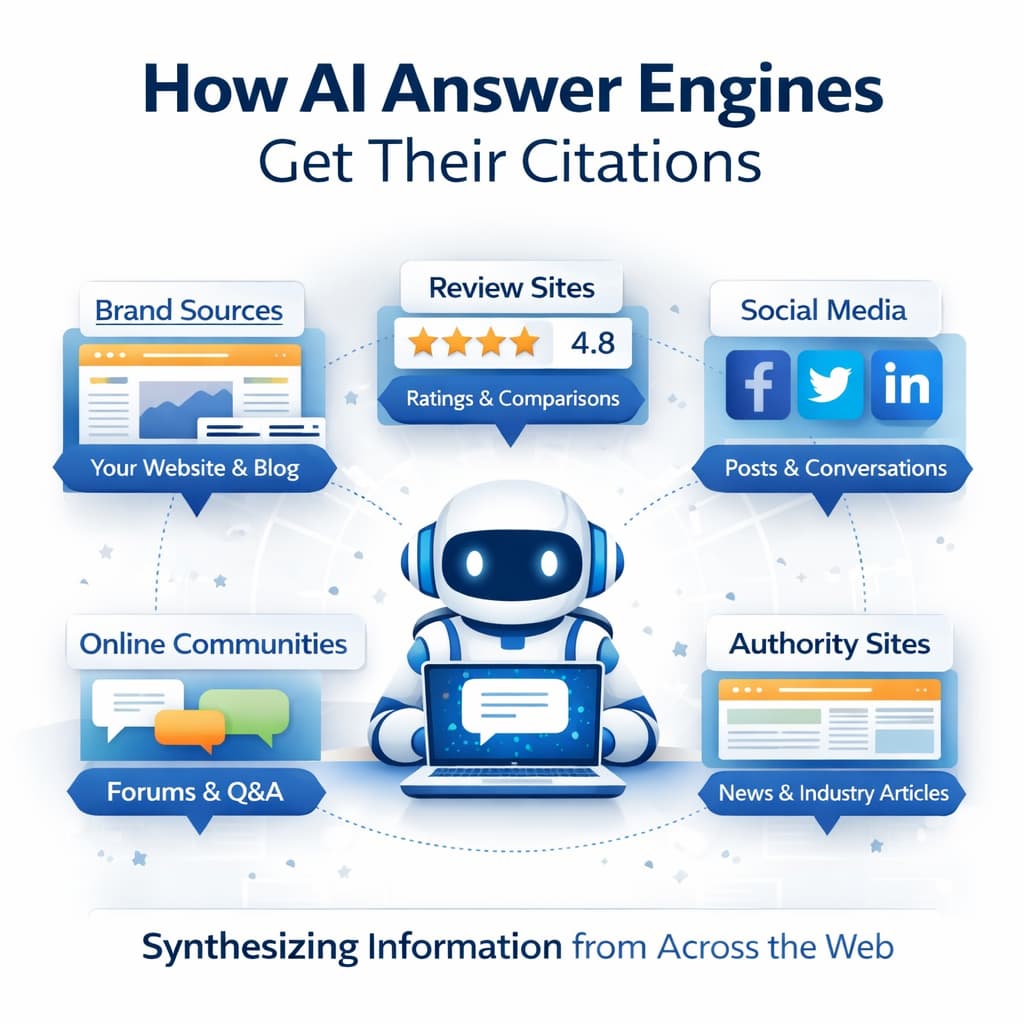
What an AI engine already knows about your brand affects whether it picks you. For a medical query, it’ll lean toward the Mayo Clinic over an anonymous blog. Trust is built across the open web through coverage, mentions, references, and reputation — not just on your own site. The strongest signal is consistent, high-quality presence across the sources AI engines treat as authoritative.
Entity Consistency
Use the same names for the same things. If your product is “Acme Analytics Pro,” call it that everywhere — not “AAP” on one page and “our analytics tool” on another. Consistent naming helps AI engines build an accurate entity model of your brand, which directly affects whether they cite you correctly for relevant queries.
Structured Data
The schema debate gets heated, but the data are consistent: studies examining schema almost always find a small positive correlation with AI citations. LLMs don’t ingest schema the way a parser does, but they appear to see it during search-based grounding. The effect is modest but real. Mark up your articles, products, FAQs, and authors. It’s cheap insurance with measurable upside.
Known Source
Sometimes AI engines cite a URL purely because it’s already known from training data, no live search required. This is most common with ChatGPT and Perplexity, and it explains why older, established sites sometimes get cited even when their pages aren’t currently ranking. Being in the training data is a durable advantage and one reason consistent, long-term publishing compounds over time.
Off-Site Brand Mentions
LLMs are trained on a vast slice of the public web, including news, podcasts, YouTube transcripts, trade publications, and forums. Unlinked mentions of your brand in these places shape how the model “knows” you. Getting talked about in the right communities matters, even without a backlink. PR, podcast appearances, and industry coverage all feed this signal.
Wikipedia and Wikidata Presence
Wikipedia accounts for a stunning share of ChatGPT’s top citations — some analyses put it close to half of all sources cited. If your brand or topic warrants a Wikipedia article, getting one legitimately, following their notability rules, is a high-leverage move. A clean Wikidata entity ID anchors you across the broader knowledge graph that AI engines rely on for fact-checking and entity resolution.
Author Entity Markup
Named bylines, author bios, sameAs links to LinkedIn or ORCID, and proper author schema all signal that real, identifiable humans stand behind the content. This is E-E-A-T in practice, and it carries into AI citation decisions the same way it carries into Google rankings. Anonymous content with no author byline is harder to trust, and AI engines act on that.
Consistent NAP and Brand Facts
Your founding year, HQ, founder names, and product details should match across your site, your About page, press coverage, LinkedIn, Crunchbase, and third-party listings. Conflicting facts make an AI engine hedge or skip you entirely in favor of a source it can verify. Run a quarterly audit on your core brand facts across the top ten places they appear online.
Reddit and UGC Signals
Reddit has become one of the most-cited sources across ChatGPT, Perplexity, and Google AI Overviews. Authentic community discussion of your product, brand, or topic now functions as a ranking input. This doesn’t mean astroturfing — which gets caught and punished — but it does mean genuine community engagement, helpful answers, and real conversations about your space have measurable AI-visibility value.
Theme 7: Measurement and Iteration
You can’t optimize what you can’t see. This last theme isn’t a ranking factor in the traditional sense, but it’s what separates teams that move the needle from teams that guess.
Citation Tracking Coverage
A growing set of tools — Profound, AthenaHQ, Peec, Otterly, and others — monitor which prompts cite your domain across major AI engines. They show you which engines cite you most, for which queries, alongside which competitors. Without this visibility, you’re optimizing blind. Pick one tool, set up your priority prompts, and review the data weekly.
Engine Segmentation
ChatGPT, Perplexity, Gemini, Google AI Overviews, and Claude all cite differently. Their training data differs. Their grounding behavior differs. Their preferences for source types differ. Treating “AI search” as a single channel obscures what’s working and what isn’t. Track each engine separately, identify your strongest and weakest, and adjust tactics per engine rather than chasing a single average.
Pulling It All Together
If you boil this entire framework down, four principles emerge: relevance, trust, topical authority, and extractability. Rank for the right queries, build the trust signals that make engines pick you, cover topics deeply enough to show up across fan-outs, and structure your content so the answer is easy to lift.
The most reassuring finding from the research is also the most actionable: the foundations of AI citation overlap heavily with the foundations of good SEO and good writing. You don’t need a separate playbook. You need to execute the fundamentals better, add a few new tactics — definition-first openings, fan-out coverage, original data, entity consistency — and pay attention to where AI engines actually find and cite you.
The teams winning AI citations in 2026 aren’t doing anything mystical. They’re publishing genuinely useful content, structured for both humans and machines, and they’re measuring the results closely enough to know what’s working. That’s the playbook. The only question is whether you’ll run it.
Frequently Asked Questions
How are AI citations different from traditional SEO rankings?
Traditional SEO ranks your page in a list of links where users click through to read. AI citations work differently: the engine reads your content, extracts specific facts, and uses them to build an answer, then credits you with a clickable link inside that answer. You’re not competing for a position on a results page anymore. You’re competing to be one of three to five sources the AI trusts enough to quote.
Do I need separate content for AI search and Google?
No, but you do need smarter content. The overlap between what ranks well on Google and what AI cites is significant — around 60–70% of the signals are shared. The difference comes down to structure and specificity. AI engines reward definition-first openings, self-contained passages, and quantified claims more aggressively than Google does. Optimize for both at once by writing clearly, structuring content for extractability, and backing every claim with specifics.
Which AI engine cites the most sources?
Perplexity tends to cite the most sources per answer, often listing 5–10 references. ChatGPT search typically cites 3–5 sources. Google AI Overviews usually show 3–4 visible citations, though it draws on more behind the scenes. Gemini sits in a similar range. Each engine has its own preferences for source types — Perplexity leans on news and primary research, ChatGPT favors Reddit and Wikipedia, Google AI Overviews mirrors traditional search results more closely.
How long does it take to start earning AI citations?
For pages on engines that use live search (Perplexity, Google AI Overviews, ChatGPT search), citations can begin within days of indexing if the content is strong and ranks for relevant queries. For training-data citations on platforms like base ChatGPT, the timeline is much longer — months to years — because the page has to be included in the next training cycle. Most teams see meaningful citation growth within 60–90 days of focused effort.
Can I get cited without ranking on Google?
Yes, and it happens more often than you’d expect. AI engines run their own fan-out searches and pull from multiple indexes, including Bing. Some research suggests the overlap between Google’s top results and AI citations has dropped below 30% in certain query types. Strong entity signals, Wikipedia presence, Reddit mentions, and Bing indexing can earn you citations even when your Google rankings are mediocre.
Does schema markup actually help with AI citations?
Yes, but modestly. LLMs don’t ingest schema the way a structured-data parser does, but they appear to see it during live grounding. Across studies examining schema and AI citations, the correlation is small but consistently positive. Mark up articles, products, FAQs, and authors. Don’t expect schema alone to move the needle, but treat it as cheap insurance that compounds with other signals.
What’s the single most important AI citation ranking factor?
If you have to pick one, it’s URL accessibility — because nothing else matters if AI bots can’t reach your page. If you’re past that and asking which factor moves citations most, the answer is search rank combined with fan-out coverage. Ranking well for the primary query and the related sub-queries an AI engine generates is the strongest predictor of getting cited across every major platform.
If you’re ready to turn these AI citation principles into measurable visibility across ChatGPT, Perplexity, Gemini, and Google AI Overviews, Megrisoft’s AI Visibility Services help brands earn the authority signals, entity presence, and citation-worthy coverage that compound into long-term search growth. Book a strategy call to discuss how we can position your brand inside the answers your audience is already asking for.
1
Leave a Comment