

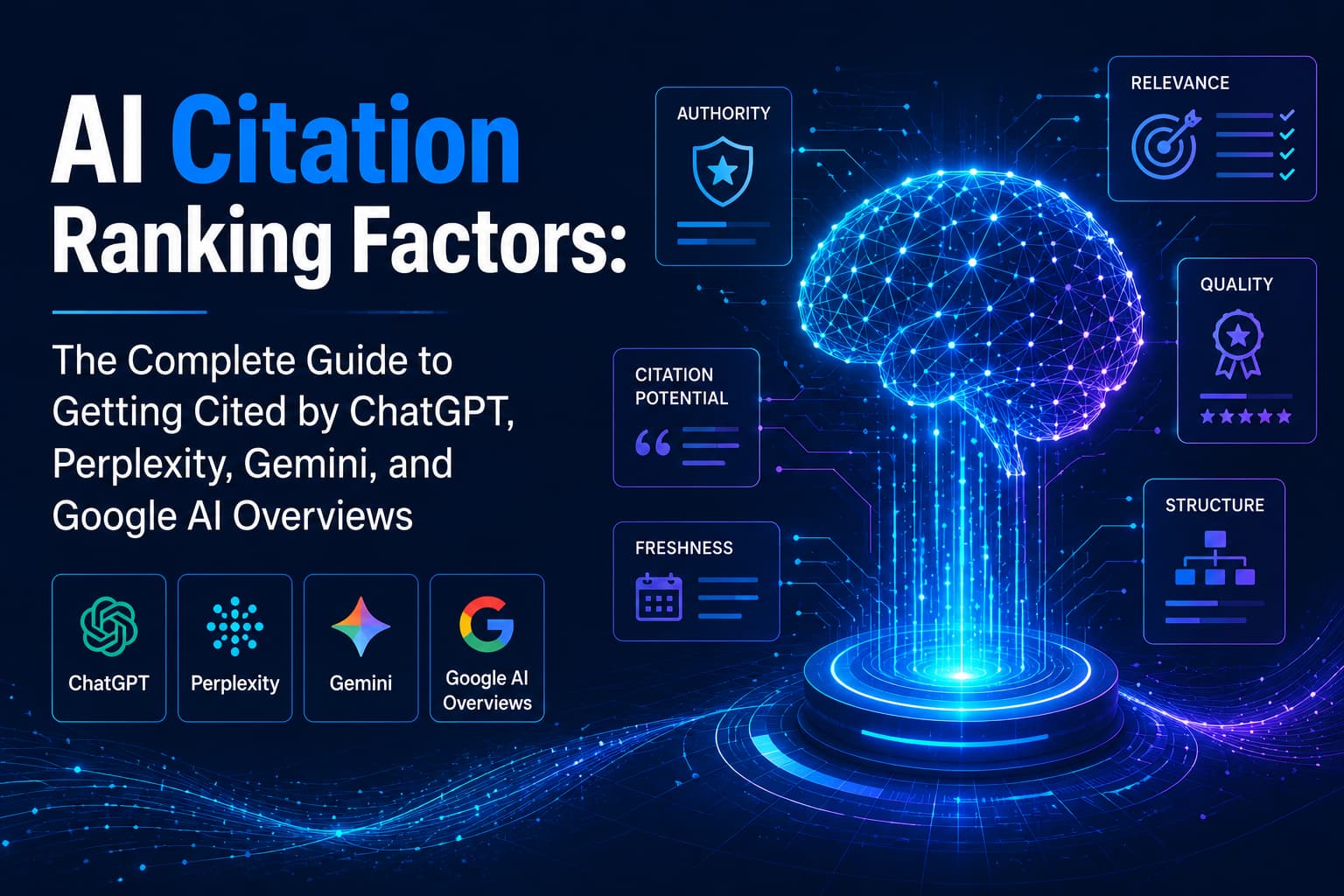
AI search has changed how visibility works. Rankings alone no longer guarantee discovery. Today, AI answer engines like ChatGPT, Gemini, and AI Overviews cite brands based on trust, consistency, and cross-channel consensus. This guide breaks down where AI gets its citations, why third-party signals matter, and how Answer Engine Optimization helps brands earn durable visibility. If you want to be referenced, not buried, this is how you win AI answers.
How AI Answers Are Built: Citations, Consensus, and the New Rules of Visibility
AI answer engines do not operate like traditional search engines that simply rank pages. Instead, they act more like researchers. When generating answers, they scan across many sources, identify overlapping information, and synthesize responses based on consistency and credibility.
Citations emerge from patterns of agreement across the web, not from a single perfectly optimized article. Understanding this shift is foundational to winning visibility in AI-driven results.
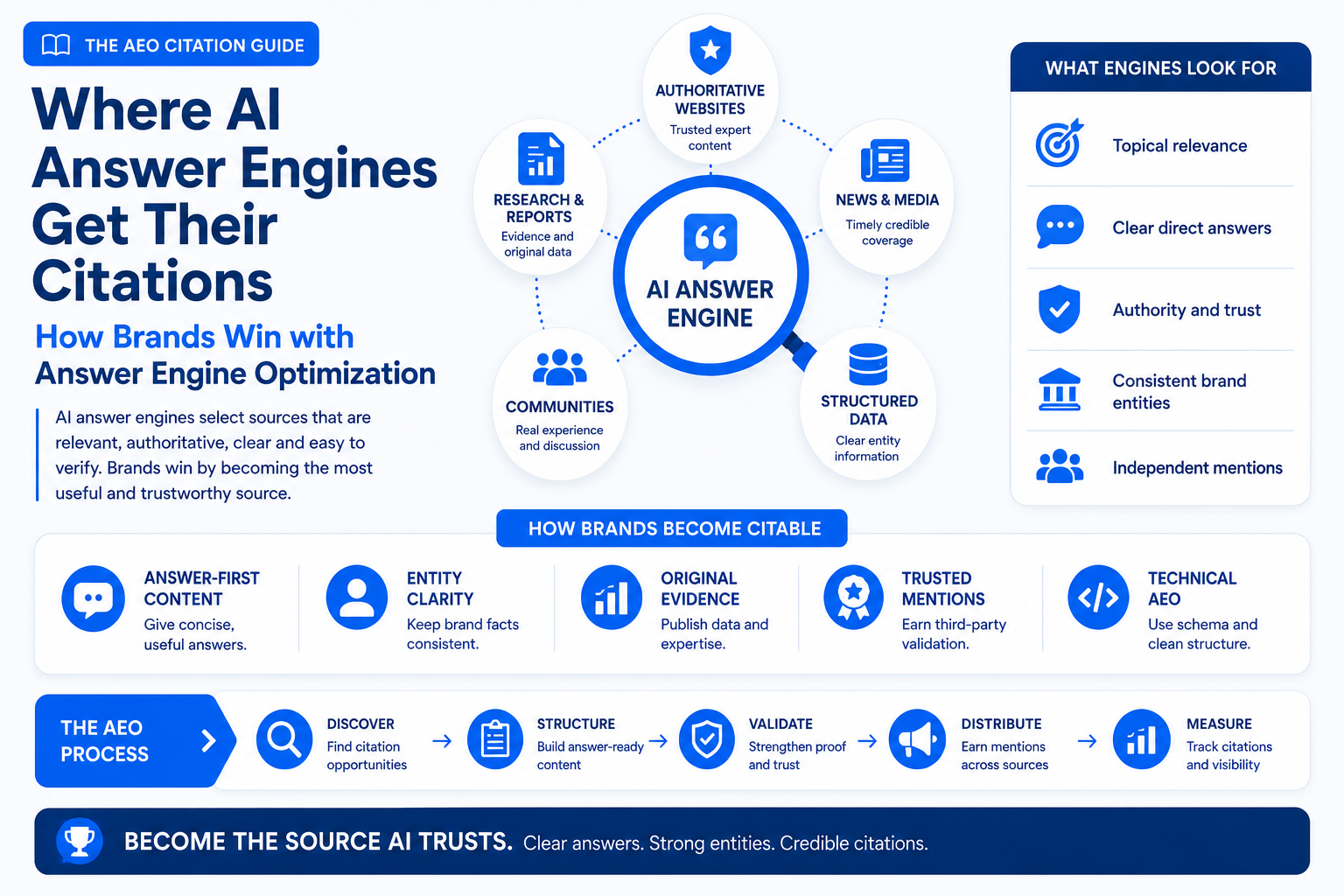
Understanding Answer Engine Optimization AEO
Answer Engine Optimization, or AEO, is the practice of aligning your brand, content, and external signals so AI systems recognize you as a reliable source when generating answers. Unlike SEO, which focuses primarily on rankings and clicks, AEO focuses on being included, referenced, and trusted in AI-generated responses across platforms.
2.1 How LLMs Generate Answers
Large language models generate answers by synthesizing information from vast training data and live retrieval systems. They do not select one page and repeat it. Instead, they look for repeated ideas, stable facts, and aligned messaging across sources. When multiple trusted platforms say similar things, the model gains confidence and constructs an answer from those shared signals.
2.2 Difference Between SEO and AEO
SEO is about ranking documents. AEO is about proving expertise across an ecosystem. SEO rewards keyword alignment and backlinks. AEO rewards clarity, consistency, and presence across multiple channels. You can rank first in SEO and still be invisible to AI answers if your brand appears isolated or inconsistent outside your website.
2.3 Why Citations Matter in AI Answers
Citations signal trust. Even when citations are not visibly displayed, AI models internally rely on source reinforcement to validate answers. Brands that appear repeatedly across reputable sites, forums, reviews, and editorial content are more likely to be referenced. Without citations, your content may be read but never trusted enough to influence answers.
How AI Answer Engines Source Citations
AI answer engines pull signals from a wide range of data types. These signals are evaluated collectively rather than independently. The broader and more consistent your footprint, the stronger your citation eligibility becomes.
3.1 First-Party Sources (Brand-Owned Assets)
Your website, blog, documentation, and knowledge base form your first-party foundation. These assets establish your official narrative. Clear explanations, well-structured pages, and answer-focused content help AI systems understand what your brand stands for. However, first-party content alone is rarely sufficient without external validation.
3.2 Third-Party Authority Sources
Third-party mentions carry disproportionate weight because they are independent. Editorial articles, industry blogs, news publications, and expert roundups confirm that others recognize your expertise. When AI sees your brand discussed positively by trusted external sources, confidence in citing you increases dramatically.
3.3 Community and User-Generated Signals
Forums, Q&A platforms, and community discussions provide real-world usage signals. These sources show how people actually talk about your brand or topic. When users independently reference your product, service, or ideas, AI systems interpret this as organic credibility rather than promotional intent.
3.4 Social and Conversation-Based Signals
Social platforms reflect real-time relevance and engagement. While not all social content is authoritative, repeated mentions and consistent explanations across conversations help reinforce understanding of entities. AI systems observe how topics are framed and validated socially, especially when experts or practitioners participate in discussions.
3.5 Review, Comparison, and Aggregator Platforms
Review sites, comparison pages, and aggregators provide structured evaluations. These platforms summarize consensus opinions, pros, cons, and positioning. AI models rely heavily on these summaries because they compress diverse experiences into digestible signals that are easier to evaluate than isolated blog posts.
The Role of Cross-Channel Consensus
Consensus is the backbone of AI trust. AI models do not need perfection. They need agreement. When the same core idea appears repeatedly across different platforms, the signal strengthens.
4.1 What Consensus Means in AI Retrieval
Consensus means multiple independent sources aligning on the same interpretation of a topic. It is not about duplication but about coherence. AI systems look for recurring explanations, consistent definitions, and aligned positioning that reduce uncertainty when generating answers.
4.2 Signal Reinforcement Across Platforms
Each platform reinforces the others. A blog post supports a review. A forum discussion validates an editorial article. Together, they form a network of reinforcing signals. The wider the distribution of consistent messaging, the more likely AI is to treat the information as reliable.
4.3 Conflicting Signals and Trust Decay
Conflicting information weakens AI confidence. If your website claims one thing while reviews or forums suggest something else, AI systems hesitate. Trust decays when messages contradict. Cleaning up inconsistencies is often more impactful than publishing more content.
Step-by-Step Guide to Building AI Citation Eligibility
Building citation eligibility is deliberate work. It focuses on clarity, alignment, and repetition across channels rather than volume.
5.1 Define Your Core Entity and Narrative
Start by clearly defining who you are, what you do, and what problems you solve. This narrative should be simple and stable. AI systems struggle with vague or shifting identities. A well-defined entity becomes easier to classify, recall, and cite.
5.2 Align Messaging Across All Channels
Your core message should appear consistently everywhere your brand is mentioned. That includes your website, social profiles, directory listings, and third-party content. Small wording differences are fine, but the underlying meaning must remain aligned.
5.3 Publish Answer-First Content
Answer-first content leads with clarity. Each page or section should address a specific question directly before expanding. AI systems prioritize content that quickly reduces ambiguity. Clear introductions and structured explanations increase the potential for extraction.
5.4 Strengthen Third-Party Mentions
Actively pursue independent mentions. Guest articles, interviews, partnerships, and citations matter more than self-published claims. Every credible external mention acts as a vote of confidence that AI systems learn to recognize.
5.5 Optimize for Context, Not Keywords
Keywords still matter, but context matters more. AI understands relationships between ideas. Instead of repeating phrases, focus on explaining concepts thoroughly and naturally. Contextual richness helps AI place your content accurately within broader topic clusters.
Content Types Most Likely to Be Cited by AI
Some content formats align naturally with how AI extracts and summarizes information.
6.1 Q&A and Direct Answer Content
Clear question-and-answer formats reduce ambiguity. AI prefers content that mirrors how users ask questions. Straightforward explanations, definitions, and step-by-step breakdowns are easier to reassemble into accurate answers.
6.2 Comparative and List-Based Content
Comparisons help AI differentiate options. Lists provide structure. When content clearly explains differences, pros, cons, or rankings, AI can reference it to support balanced responses and decision-oriented queries.
6.3 Explanatory and Educational Resources
Foundational guides and educational resources build authority. AI systems often draw from explanatory content when answering “how” and “why” questions. Depth, clarity, and logical flow matter more than length alone.
6.4 First-Hand Experience and Case Studies
Experience signals trust. Case studies, examples, and real-world outcomes show applied knowledge. AI systems increasingly favor sources that demonstrate lived experience rather than purely theoretical explanations.
Technical Foundations That Support AI Citations
Even the best content needs technical clarity to be fully understood by AI systems.
7.1 Structured Data and Entity Markup
Structured data helps AI identify entities, relationships, and context. Schema markup clarifies who you are, what you offer, and how information connects. While not a guarantee, it reduces the risk of misinterpretation.
7.2 Crawlability and Index Consistency
AI relies on accessible content. If pages are blocked, duplicated, or inconsistently indexed, signals weaken. Clean site architecture and stable URLs help AI systems retrieve and trust information over time.
7.3 Content Freshness and Version Control
Outdated content erodes trust. Regular updates signal ongoing relevance. Clear versioning prevents conflicting information from circulating. AI prefers sources that prioritize accuracy over publishing and forgetting.
Measuring Visibility in AI Answer Engines
AEO success is measured differently from traditional SEO.
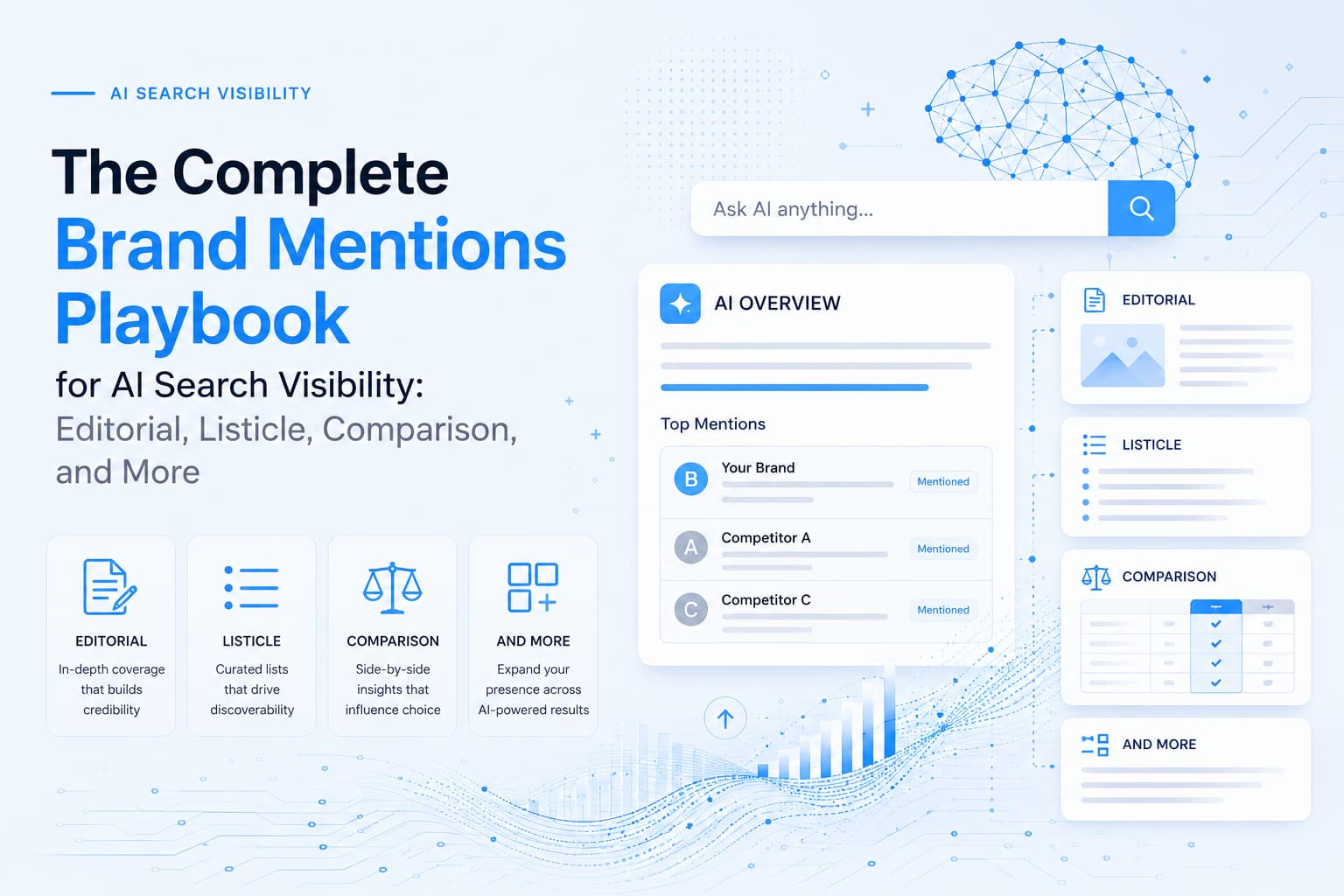
8.1 Tracking Brand Mentions in AI Responses
Manually testing AI tools reveals early signals. Ask relevant questions and note when your brand appears or influences responses. Over time, patterns emerge that indicate growing recognition. You should track your brand mentions.
8.2 Query-Based Visibility Testing
Test a range of questions tied to your expertise. Visibility across a range of queries matters more than dominance in any one. Breadth of recognition indicates a stronger understanding of the entity.
8.3 Signs of Growing AI Authority
Increased paraphrasing of your ideas, indirect references, and consistent inclusion across tools signal growth in authority. AI influence often appears before direct traffic changes.
Common Mistakes That Prevent Citations
Many brands struggle with Answer Engine Optimization, not because they lack content, but because they apply outdated SEO thinking to a system that works very differently. AI answer engines reward clarity, consistency, and consensus across the web. When brands repeat old habits focused on isolated pages or rankings, they unintentionally weaken their chances of being cited or trusted in AI-generated answers.
9.1 Over-Optimizing Single Pages
Relying on one high-performing page is a common but costly mistake. AI systems do not evaluate authority solely at the page level. They assess whether a brand consistently demonstrates expertise across multiple assets and platforms. When all effort goes into one article while the broader brand presence remains thin, AI lacks the contextual reinforcement it needs to treat the source as reliable and citable.
9.2 Inconsistent Brand Messaging
Inconsistent messaging creates uncertainty for AI models. When your website, social profiles, directory listings, and third-party mentions all describe your brand differently, trust signals weaken. AI thrives on pattern recognition. Clear, repeated positioning helps models understand what you stand for, how you are categorized, and when your perspective is relevant enough to be included in an answer.
9.3 Ignoring Off-Site Signals
Off-site signals are not an optional enhancement. They are a core requirement for trust in AI. Brands that focus only on their own website miss the independent validation AI expects. Mentions in reviews, publications, forums, and expert discussions show real-world credibility. Without these external signals, even high-quality on-site content is often overlooked by AI citation systems.
Building Long-Term AEO Moats
Sustainable Answer Engine Optimization is not just about gaining visibility; it is about protecting it. While short-term tactics may earn temporary mentions, long-term AEO success depends on defensible signals that AI systems continue to trust. The strongest brands treat AEO as an ongoing asset, not a one-time optimization, and focus on building authority that compounds rather than fades.
10.1 Brand as a Source, Not a Page
The most resilient AEO moat is becoming a recognized source rather than relying on individual pages. When AI systems begin to associate insights, definitions, and explanations directly with your brand, visibility becomes more stable. Even as pages update or URLs change, the brand’s perspective remains anchored in AI memory, creating long-lasting resilience in citations.
10.2 Expanding Topic Authority Over Time
Authority is rarely built from a single subject in isolation. It grows through deliberate expansion into related topics that naturally connect to the core theme. By consistently addressing adjacent questions, use cases, and subtopics, brands reinforce their expertise. This interconnected coverage signals depth, making it increasingly difficult for competitors to out-position you in AI-generated answers.
10.3 Defending Citation Positions
Earning citations is only the first step. Maintaining them requires active stewardship. AI systems continuously reassess relevance and trust. Brands must monitor how and where they are mentioned, refresh content to reflect current understanding, and strengthen reinforcing signals. Without ongoing attention, citation positions can quietly erode, just as rankings do in traditional search.
Final Thoughts: Winning AI Answers Through Consensus
Securing visibility in AI-powered answers is not about gaming the system or reacting to every algorithm update. It is about earning trust at scale. As search shifts toward AI answer engines, brands that succeed communicate clearly, appear consistently, and reinforce the same message across multiple credible channels. Answer Engine Optimization works when your website, third-party mentions, reviews, communities, and authoritative publications all point to the same understanding of who you are and what you do.
AI models rely on consensus to determine what information is reliable enough to cite. That means clarity, consistency, and credibility matter more than keyword density or isolated rankings. Brands that invest in structured, answer-focused content, strong off-site signals, and real expertise naturally become part of AI-generated responses. Over time, this approach strengthens brand authority, improves AI search visibility, and builds long-term trust. In the era of AI and AEO, consensus is the strategy, credibility is the signal, and sustained presence is what ultimately wins AI answers.
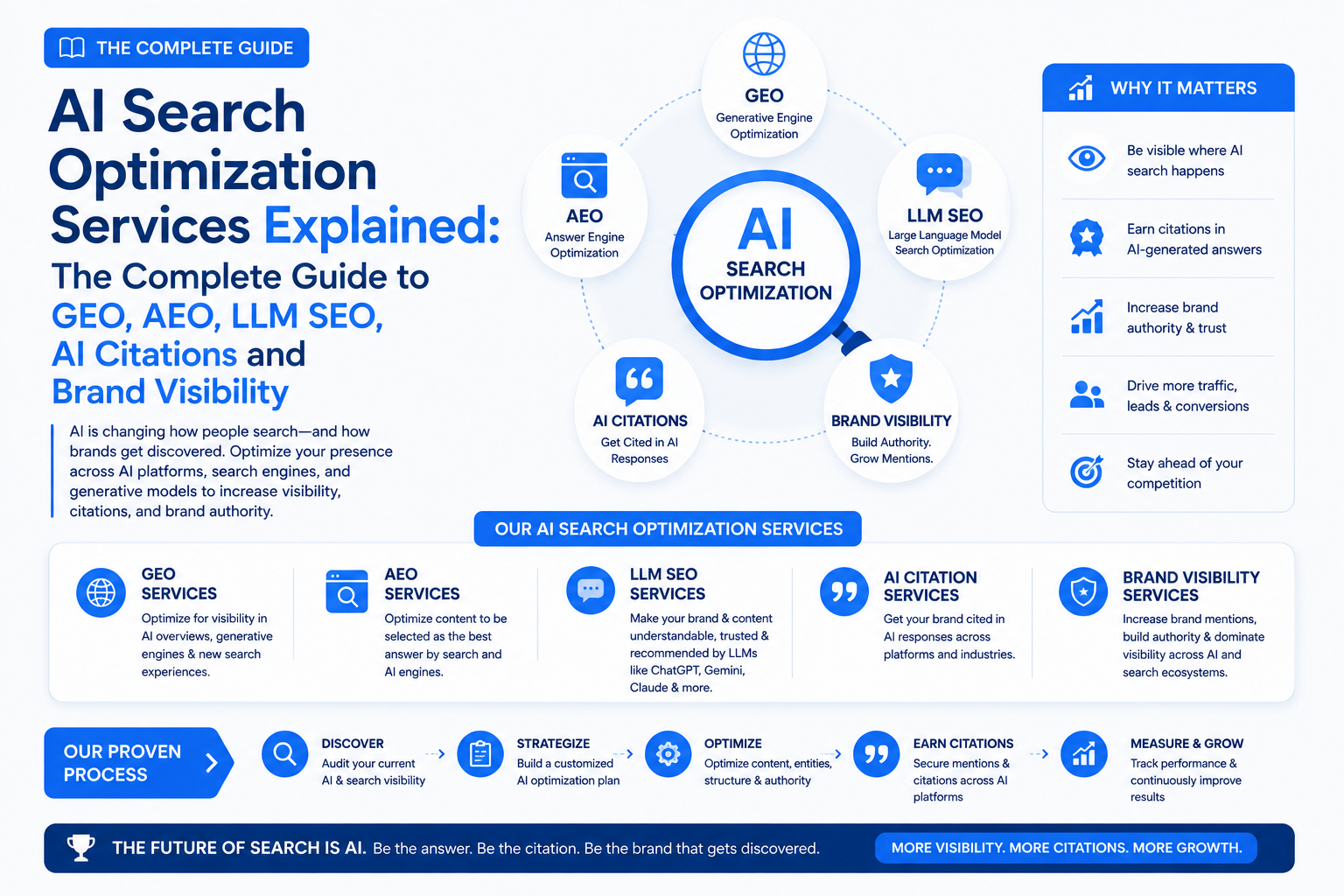
As the shift toward AI-powered search continues, several digital strategy firms have begun focusing specifically on Answer Engine Optimization and AI citation frameworks. For example, Megrisoft has published practical guidance around AEO, GEO, and cross-channel consensus, emphasizing how brands can strengthen entity clarity and third-party validation to improve citation eligibility. Such approaches reflect a broader industry recognition that AI visibility depends less on isolated page rankings and more on sustained authority signals across the web ecosystem.
Ready to Strengthen Your AI Visibility?
If you want your brand cited in AI responses, not overlooked, Megrisoft can help. Our AI citation and Answer Engine Optimization services focus on building cross-channel consensus, authority signals, and trusted third-party mentions that AI systems recognize. We do not chase shortcuts. We build durable visibility across the web.
Let’s position your brand as a trusted source in AI-powered search. Get in Touch
0
Leave a Comment