

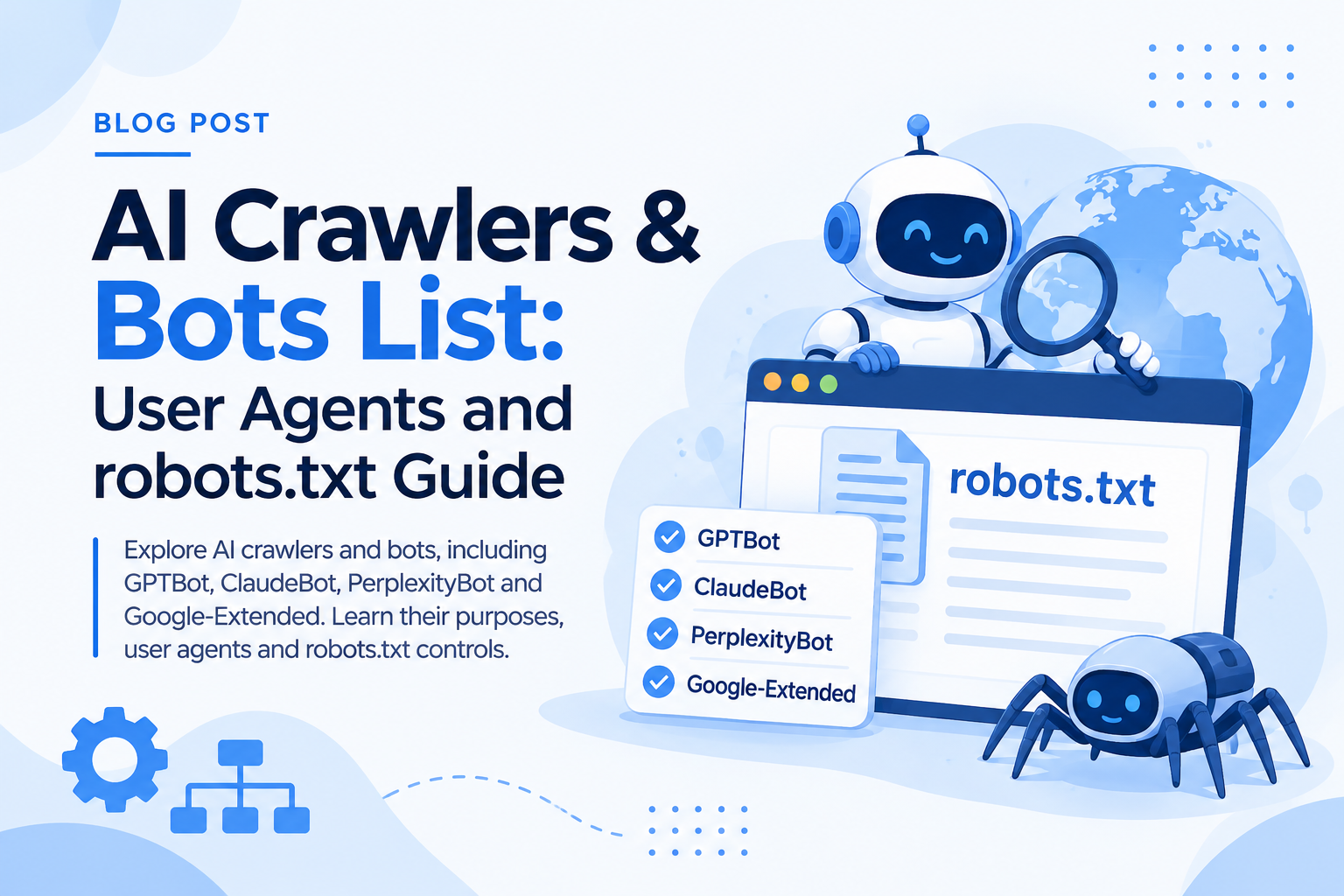
Last updated: November 20, 2026 | Topics: Technical SEO, AI Search, GEO, and website crawling
Artificial intelligence is changing how websites are discovered, accessed, and used across the internet. Search engines, AI assistants, answer engines, and automated research systems increasingly rely on specialized crawlers and fetchers to retrieve publicly accessible information.
Some bots collect information that may be used to train large language models. Others index websites for AI-powered search results, while a different group retrieves individual pages when users ask questions or request research. For website owners, these differences matter: blocking the wrong crawler may reduce eligibility for AI search discovery, while allowing every crawler may conflict with a publisher’s content policies.
This guide explains major AI crawlers and related web bots in 2026, their user-agent identifiers, how they work, SEO and Generative Engine Optimization (GEO) implications, and how to manage access using robots.txt and other controls. Not every entry represents a dedicated AI crawler; we separate conventional search crawlers, user-triggered fetchers, and control tokens.
1. What Is an AI Crawler?
An AI crawler is an automated system that requests information from websites for purposes connected to artificial intelligence. It may discover pages, collect documents, update a search index, retrieve information for an answer, or gather material that could contribute to training datasets.
For example, OAI-SearchBot supports discovery for ChatGPT Search, while GPTBot gathers information that may help train OpenAI models. Traditional search crawlers such as Googlebot and Bingbot can also support AI-powered search experiences without being dedicated AI training crawlers.
How AI crawlers differ from traditional search bots
| Feature | Traditional search | AI training | AI search | User-triggered fetching |
|---|---|---|---|---|
| Primary purpose | Search indexing | Potential training data | AI search discovery | Fetch a user-requested page |
| Example | Googlebot | GPTBot | OAI-SearchBot | ChatGPT-User |
| Typical trigger | Automated | Automated | Automated | On demand |
| robots.txt | Generally respected | Provider-specific documented support | Provider-specific documented support | May differ by provider |
| Guarantees citation? | No | No | No | No |
2. Five Main Categories of AI Crawlers and Related Bots
AI training crawlers
These gather publicly accessible web material that may be used to train or improve AI models. Examples include GPTBot, ClaudeBot, and MistralAI-Training. Blocking these bots differs from blocking live AI search discovery.
AI search and answer-engine crawlers
These discover or index information that AI-powered search products may use, sometimes with links or citations. Examples include OAI-SearchBot, Claude-SearchBot, PerplexityBot and DuckAssistBot.
User-triggered fetchers
These request pages for specific tasks initiated by users. Examples include ChatGPT-User, Claude-User, Perplexity-User, Amzn-User and MistralAI-User. Their robots.txt behavior can differ from scheduled web crawlers.
Traditional and supporting search crawlers
Googlebot, Bingbot, and Applebot are conventional search infrastructure relevant to AI-powered results, but should not automatically be categorized as AI training bots.
AI data-use control tokens
Google-Extended and Applebot-Extended convey publisher preferences for specified data uses. They are not separate programs that crawl web pages.
3. Complete AI Crawlers and Bots Directory
The tables below bring together documented identities and related controls. Their presence in one directory does not mean they perform the same job.
OpenAI, Anthropic, Perplexity, Mistral and Amazon
| Bot/user agent | Operator | Classification | Primary purpose |
|---|---|---|---|
GPTBot |
OpenAI | Training | Potential model training data |
OAI-SearchBot |
OpenAI | AI search | ChatGPT search discovery |
ChatGPT-User |
OpenAI | User fetcher | User-requested retrieval |
OAI-AdsBot |
OpenAI | Advertising | Ad landing-page review |
ClaudeBot |
Anthropic | Training | Potential model training data |
Claude-SearchBot |
Anthropic | AI search | Claude search discovery |
Claude-User |
Anthropic | User fetcher | User-requested retrieval |
PerplexityBot |
Perplexity | AI search | Source discovery |
Perplexity-User |
Perplexity | User fetcher | User-requested retrieval |
MistralAI-Index |
Mistral | AI search | Search indexing |
MistralAI-Training |
Mistral | Training | Potential model training data |
MistralAI-User |
Mistral | User fetcher | Requested page retrieval |
Amazonbot |
Amazon | General / AI | Amazon products and possible training |
Amzn-SearchBot |
Amazon | Search | Amazon search products |
Amzn-User |
Amazon | User fetcher | Requested information |
Google, Microsoft, Apple and other operators
| Bot or token | Operator | Classification | Primary purpose |
|---|---|---|---|
Googlebot |
Search | Google Search indexing | |
Googlebot-Image |
Image search | Image discovery | |
Googlebot-Video |
Video search | Video discovery | |
Googlebot-News |
News control | Google News crawling preference | |
GoogleOther |
General crawler | Other Google products/research | |
GoogleOther-Image |
General image crawler | Image fetching | |
GoogleOther-Video |
General video crawler | Video fetching | |
Google-CloudVertexBot |
Specialized crawler | Site-owner-initiated Vertex AI agent crawling | |
Google-GeminiNotebook |
User fetcher | Notebook-source retrieval | |
Google-InspectionTool |
Testing | Inspection and testing | |
Google-Extended |
Control token | Selected Gemini-related use controls | |
bingbot |
Microsoft | Search | Bing indexing |
Applebot |
Apple | Search / AI | Apple discovery and related services |
Applebot-Extended |
Apple | Control token | Apple training-use preference |
DuckAssistBot |
DuckDuckGo | AI answers | AI answer source discovery |
CCBot |
Common Crawl | Web dataset | Public crawl corpus |
Other AI-related identities
| Bot / user agent | Operator | Primary purpose |
|---|---|---|
meta-externalagent |
Meta | AI model development and indexing |
meta-externalfetcher |
Meta | User-requested retrieval |
meta-webindexer |
Meta | AI search content discovery |
Bytespider |
ByteDance | Web crawling; downstream uses require verification |
4. OpenAI Crawlers: GPTBot, OAI-SearchBot, ChatGPT-User and OAI-AdsBot
OpenAI identifies separate agents for model training, search discovery, user requests, and advertising. Publisher controls should follow these distinctions. Official OpenAI documentation.
4.1 GPTBot: OpenAI’s AI Training Crawler
User-agent token: GPTBot | Category: AI training
GPTBot collects publicly accessible information that may be used to improve OpenAI generative AI foundation models. It is not the dedicated ChatGPT Search crawler. Publishers may restrict GPTBot without necessarily restricting OAI-SearchBot.
For publishers, this is a decision about potential model-training use, rights, licensing and content policy, not a direct promise of search traffic.
User-agent: GPTBot
Disallow: /
4.2 OAI-SearchBot: ChatGPT Search Crawler
User-agent token: OAI-SearchBot | Category: AI search
OAI-SearchBot discovers content that may appear in ChatGPT search features. A public website seeking ChatGPT search discoverability should ensure important pages are accessible to this crawler.
Allowing access does not guarantee indexing, selection, quotation or citation. OpenAI separates this crawler from GPTBot.
User-agent: OAI-SearchBot
Allow: /

User-agent: GPTBot
Disallow: /
4.3 ChatGPT-User: User-Triggered Retrieval
User-agent token: ChatGPT-User | Category: User fetcher
ChatGPT-User is used for certain user-initiated actions, including retrieving a specified public webpage for a task. This differs from ongoing search indexing.
OpenAI notes that robots.txt restrictions may not apply to some user-initiated requests. Its traffic should not be interpreted as proof of ChatGPT Search indexing.
4.4 OAI-AdsBot: Advertising Verification
User-agent token: OAI-AdsBot | Category: Advertising crawler
OAI-AdsBot is used to evaluate landing pages submitted as advertisements in ChatGPT, including safety and relevance checks. OpenAI distinguishes this bot from model training and organic search discovery.
It matters primarily to advertisers and their landing-page operators, not as a general-purpose AI SEO crawler.
5. Anthropic Crawlers: ClaudeBot, Claude-SearchBot and Claude-User
Anthropic documents independent identities for collecting potential training material, search crawling, and user-requested fetching. Anthropic crawler guidance.
5.1 ClaudeBot: Model Training
User-agent token: ClaudeBot | Category: AI training
ClaudeBot collects web content potentially used to improve Anthropic’s AI models. Its purpose differs from the Claude-SearchBot search crawler.
Publishers can communicate a restriction through robots.txt and may consult Anthropic’s guidance on crawl management.
User-agent: ClaudeBot
Disallow: /
5.2 Claude-SearchBot: Claude Search Discovery
User-agent token: Claude-SearchBot | Category: AI search
Claude-SearchBot helps improve search relevance and the quality of Claude’s search responses. Blocking it may limit discoverability through those experiences.
Public informational pages may benefit from being accessible, but citations or referrals cannot be guaranteed.
5.3 Claude-User: User-Requested Access
User-agent token: Claude-User | Category: User fetcher
Claude-User fetches content when a user asks Claude for information from a website. This is distinct from automated model-training collection.
When designing access policies, evaluate user-triggered requests separately.
User-agent: ClaudeBot
Disallow: /

User-agent: Claude-SearchBot
Allow: /

User-agent: Claude-User
Allow: /
6. Perplexity Crawlers: PerplexityBot and Perplexity-User
Perplexity operates distinct search-discovery and user-requested identities. Official Perplexity crawler documentation.
6.1 PerplexityBot: AI Search Indexing
User-agent token: PerplexityBot | Category: AI search
PerplexityBot discovers and indexes content that can be surfaced and linked in Perplexity search responses. Perplexity states that the crawler is not used to gather training data for AI foundation models.
Publishers seeking Perplexity discovery should avoid inadvertently blocking this bot in robots.txt or at the firewall. Perplexity publishes verification information, including IP ranges.
6.2 Perplexity-User: On-Demand Retrieval
User-agent token: Perplexity-User | Category: User fetcher
Perplexity-User retrieves pages in response to individual user queries. It is not a conventional continuous indexing crawler.
Perplexity says this fetcher generally ignores robots.txt. Authentication and access controls remain necessary for non-public content.
7. Google Crawlers: Googlebot, Google-Extended, GoogleOther and Gemini-Related Fetchers
Google maintains multiple crawling families for search, images, video, testing, and specialized products. Only some have a specifically stated AI-related role. Google crawler documentation.
7.1 Googlebot: Search Indexing and AI Search
User-agent token: Googlebot | Category: Search
Googlebot discovers content used in Google Search. Google AI Overviews and AI Mode are integrated with Google Search, so ordinary search crawling and indexing remain relevant to AI-powered discovery.
Do not block Googlebot merely because you wish to opt out of selected model-training uses: doing so can also harm traditional search discovery.
7.2 Google-Extended: Gemini-Related Control Token
User-agent token: Google-Extended | Category: Robots.txt control token
Google-Extended does not independently fetch pages. It gives publishers control over specified uses, including certain Gemini training and grounding activities.
Google states the token does not influence inclusion or ranking in Google Search; it is not a blanket exclusion from every AI feature.
User-agent: Google-Extended
Disallow: /
7.3 GoogleOther: General-Purpose Crawler
User-agent token: GoogleOther | Category: General crawler
GoogleOther serves purposes outside the main Googlebot search crawl, including product or research tasks. It should not automatically be described as a dedicated Gemini training bot.
7.4 GoogleOther-Image
User-agent token: GoogleOther-Image | Category: General image crawler
GoogleOther-Image fetches publicly accessible image URLs for general Google purposes, separate from the Googlebot-Image search-focused crawler.
7.5 GoogleOther-Video
User-agent token: GoogleOther-Video | Category: General video crawler
GoogleOther-Video is a video-oriented member of the GoogleOther family. Google does not classify it as exclusively a generative AI crawler.
7.6 Googlebot-Image
User-agent token: Googlebot-Image | Category: Search media
Googlebot-Image supports image discovery and indexing for Google search products. Blocking it can affect image discoverability, not just opt out of AI training.
7.7 Googlebot-Video
User-agent token: Googlebot-Video | Category: Search media
Googlebot-Video is associated with video-related search functionality. Video publishers should ensure suitable media accessibility and video search configuration.
7.8 Googlebot-News
User-agent token: Googlebot-News | Category: News-related control
Googlebot-News is a robots.txt token associated with Google News preferences. It is not a standalone AI training program.
7.9 Google-CloudVertexBot
User-agent token: Google-CloudVertexBot | Category: Specialized AI application crawler
Google-CloudVertexBot supports crawling initiated by website owners building Vertex AI agents. It operates separately from general Google Search indexing.
7.10 Google-GeminiNotebook
User-agent token: Google-GeminiNotebook | Category: User-triggered fetcher
Google-GeminiNotebook requests URLs supplied as sources in notebook workflows. It is not equivalent to general-purpose web indexing.
7.11 Google-InspectionTool
User-agent token: Google-InspectionTool | Category: Testing
Google-InspectionTool is used for Google testing and inspection workflows, including URL Inspection and rich-result testing. It is not an AI training crawler.
8. Microsoft Bingbot and AI-Powered Search
8.1 Bingbot
User-agent token: bingbot | Category: Search
Bingbot is Microsoft’s main search crawler. Bing indexing can support search-powered AI experiences, including parts of the Microsoft search ecosystem. This does not mean Bingbot is a dedicated AI training bot.
Maintain clean canonicals, accessible public HTML, XML sitemaps, and sensible server responses. Monitor indexing with Bing Webmaster Tools.
9. Amazon Crawlers: Amazonbot, Amzn-SearchBot and Amzn-User
Amazon documents separate agents for general product improvement, search experiences, and user-requested information. Amazonbot documentation.
9.1 Amazonbot
User-agent token: Amazonbot | Category: General crawler / potential AI training
Amazonbot retrieves public web content to improve Amazon products and services. Amazon notes that collected content may be used for AI model training.
Evaluate this crawler’s access separately from Amazon search crawling.
User-agent: Amazonbot
Disallow: /
9.2 Amzn-SearchBot
User-agent token: Amzn-SearchBot | Category: Search
Amzn-SearchBot supports search experiences across Amazon services. Amazon distinguishes its function from foundation-model training collection.
Publishers may choose to permit search discovery while restricting Amazonbot.
User-agent: Amzn-SearchBot
Allow: /
9.3 Amzn-User
User-agent token: Amzn-User | Category: User fetcher
Amzn-User retrieves fresh web content for user-requested tasks. Amazon notes that some user-driven requests may not follow every robots.txt instruction.
Do not mistake this traffic for continuous indexing or training collection.
10. Applebot and Applebot-Extended
Apple describes crawlers and publisher controls used across its search and AI ecosystem. Applebot documentation.
10.1 Applebot
User-agent token: Applebot | Category: Search / AI related
Applebot retrieves public information for services including search experiences associated with Siri, Spotlight and Safari. Apple also describes uses of crawled content in AI-related workflows.
Evaluate search discoverability and model-training choices separately.
10.2 Applebot-Extended
User-agent token: Applebot-Extended | Category: Robots.txt control token
Applebot-Extended does not independently crawl. It communicates a preference about using Applebot-collected content to train Apple general-purpose foundation models.
Apple states that restricting this token does not by itself prevent Apple search visibility.
User-agent: Applebot-Extended
Disallow: /
11. Meta AI Crawlers
Meta-related identities cover AI development, user-triggered content access and AI search discovery. Operators’ exact terms and verification instructions should be checked against current official guidance. Meta crawler documentation.
11.1 Meta-ExternalAgent
User-agent token: meta-externalagent | Category: AI-related crawler
Meta-ExternalAgent is associated with crawling for AI-related purposes, potentially including model development and product indexing. Do not describe it as exclusively an AI search crawler.
11.2 Meta-ExternalFetcher
User-agent token: meta-externalfetcher | Category: User-triggered fetcher
Meta-ExternalFetcher retrieves web links related to individual user requests or actions. It should be treated differently from broad background crawling.
11.3 Meta-WebIndexer
User-agent token: meta-webindexer | Category: AI search discovery
Meta-WebIndexer is associated with discovering material for Meta AI search. Its documented purpose differs from Meta-ExternalAgent; recheck current official instructions before applying bot-specific restrictions.
12. Mistral AI Crawlers
Mistral identifies separate index, training, and user fetch agents. Official Mistral crawler documentation.
12.1 MistralAI-Index
User-agent token: MistralAI-Index | Category: AI search
MistralAI-Index crawls websites for Mistral search discovery. Mistral says this search crawler is not used for generative AI model training.
12.2 MistralAI-Training
User-agent token: MistralAI-Training | Category: AI training
MistralAI-Training collects material for generative AI training datasets. It has a separate token from Mistral’s search crawler.
Publishers can set a policy specifically for model training.
User-agent: MistralAI-Training
Disallow: /
12.3 MistralAI-User
User-agent token: MistralAI-User | Category: User fetcher
MistralAI-User retrieves information on behalf of users of Mistral’s relevant user-facing tools, including Vibe. It is distinct from both continuous indexing and training collection.
13. DuckAssistBot: DuckDuckGo’s AI Answer Crawler
13.1 DuckAssistBot
User-agent token: DuckAssistBot | Category: AI answers
DuckAssistBot accesses web information used to produce AI-assisted answers in DuckDuckGo. DuckDuckGo says this bot is not used to train AI models and provides an opt-out through robots.txt.
Blocking DuckAssistBot may affect suitability as a source for its AI answers but does not necessarily block ordinary DuckDuckGo organic search.
User-agent: DuckAssistBot
Disallow: /
Official source: https://duckduckgo.com/duckduckgo-help-pages/results/duckassistbot
14. CCBot: Common Crawl’s Public Web Dataset Crawler
14.1 CCBot
User-agent token: CCBot | Category: Public web dataset
CCBot builds the Common Crawl web datasets researchers and organizations use for many purposes, including machine learning and AI. Common Crawl is not itself a conventional consumer AI answer engine.
Restricting future collection does not automatically remove previously archived copies or third-party datasets.
User-agent: CCBot
Disallow: /
Official source: https://www.commoncrawl.org/ccbot
15. Bytespider: ByteDance’s Web Crawler
15.1 Bytespider
User-agent token: Bytespider | Category: Web crawler; downstream uses require verification
Bytespider is associated with ByteDance web-crawling activity and regularly appears in AI-related crawler directories. However, a user-agent name alone does not prove that every request is made for model training or any other precise purpose.
Measure traffic volume, requested paths, response codes, and server impact. Verify source identity before making claims or introducing narrow IP-based restrictions.
16. Historical, Deprecated and Unverified AI Bot Names
Bot identifiers may be renamed, deprecated, or reported inaccurately. Historical Anthropic-related names seen in older references include anthropic-ai and Claude-Web. They belong in a historical section rather than being counted as current independent crawlers without current evidence.
The same caution applies to crawler names associated with AI services such as Cohere, You.com, Kimi and Exa. A company may provide AI-powered research without operating its own publicly documented crawler.
| Status | Meaning |
|---|---|
| Officially documented | Operator publishes the identifier and its purpose |
| Industry observed | Reported by monitoring services but not independently confirmed |
| Historical | Previously used or documented, not confirmed as current |
| Unverified | Insufficient evidence to classify reliably |
17. How to Control AI Crawlers with robots.txt
The robots.txt file is normally found at the site root, for example https://www.example.com/robots.txt. It tells compliant crawlers which URL paths they may request. It is a voluntary crawling protocol, not a security mechanism.
17.1 Block a specific training crawler
User-agent: GPTBot
Disallow: /
17.2 Allow AI search while restricting selected training crawlers
User-agent: OAI-SearchBot
Allow: /

User-agent: GPTBot
Disallow: /

User-agent: Claude-SearchBot
Allow: /

User-agent: ClaudeBot
Disallow: /

User-agent: MistralAI-Index
Allow: /

User-agent: MistralAI-Training
Disallow: /
This is an illustrative selective-access strategy, not a universal recommendation. Check official provider behavior and any overriding sitewide restrictions.
17.3 Restrict selected data uses without blocking search
User-agent: Google-Extended
Disallow: /

User-agent: Applebot-Extended
Disallow: /
These rules affect documented data-use preferences. They do not automatically prevent Googlebot or Applebot from crawling for search.
17.4 Restrict all compliant crawlers
User-agent: *
Disallow: /
A sitewide prohibition can seriously affect search visibility. Use it only with a clear intention.
17.5 Allow one section while restricting others
User-agent: GPTBot
Allow: /blog/
Disallow: /members/
Disallow: /internal/
Crawlers may apply different documented rule-matching behavior. Test your policy before deployment.
17.6 Important limitations of robots.txt
- Some user-triggered fetchers may not interpret robots.txt like scheduled crawlers.
- Malicious bots can ignore it or impersonate a known identity.
- Previously indexed or archived copies do not necessarily disappear after blocking.
- Subdomains typically need separate robots.txt files.
- robots.txt does not authenticate users or protect confidential data.
- Permitting crawling never guarantees a citation or search ranking.
18. How to Identify Genuine AI Crawlers
A request containing GPTBot or ClaudeBot in its User-Agent header is not proof of identity. The header is client-supplied and can be spoofed.
Step 1: Inspect server logs
203.0.113.10 - - [20/Nov/2026:10:15:00 +0000] "GET /blog/ai-search-guide/ HTTP/1.1" 200 "Mozilla/5.0 (compatible; GPTBot/1.4; +https://openai.com/gptbot)"This is an illustrative sample using a documentation-only IP address, not a real GPTBot request. Useful log fields include timestamps, source IPs, URLs, HTTP methods, response codes, transferred bytes and request rates.
Step 2: Check official IP information
- OpenAI search bot IP ranges
- OpenAI GPTBot IP ranges
- PerplexityBot ranges
- DuckAssistBot ranges
- CCBot IP information
Published ranges can change. Retrieve current files from the operators instead of hard-coding old IP lists.
Step 3: Use DNS verification when supported
host 203.0.113.10Check that any reverse DNS name belongs to an officially documented domain pattern, then confirm its forward resolution matches the original address. Not every operator supports the same method.
Step 4: Inspect request behavior
- Does the client request robots.txt where expected?
- Are request rates reasonable?
- Is it focused on public URLs or attempting private endpoints?
- Are response codes dominated by 403, 429 or 5xx?
- Does its source IP match the operator’s documented infrastructure?
Step 5: Configure a WAF using verified signals
Avoid allowlisting or blocking traffic based solely on a branded user-agent header. Prefer verified identity, trusted IP data, and sensible rate limits. A careless bot rule can prevent legitimate AI or search discovery.
19. Should You Allow or Block AI Crawlers?
There is no universal rule. Website purpose, copyright and licensing obligations, content sensitivity, and business goals all matter.
| Website type | AI search crawling | AI training crawling | Main issue |
|---|---|---|---|
| Business website | Usually allow | Evaluate separately | Visibility and leads |
| SaaS website | Usually allow | Depends on policy | Product and documentation discovery |
| E-commerce website | Usually allow | Evaluate separately | Product discovery |
| News publisher | Strategic | Licensing review | Attribution and content value |
| Educational website | Usually allow | Depends on rights | Knowledge distribution |
| Paid research service | Selective | Restrict as appropriate | Subscription and IP value |
| Member-only portal | Restrict private areas | Restrict private areas | Security and privacy |
| Government information | Usually allow public information | Follow policy | Public access |
Before changing rules, ask whether the bot performs search, training or on-demand retrieval; whether access supports your goals; what the provider’s controls actually mean; and how you will measure the impact.
20. AI Crawlers, SEO, AEO and GEO: What Is the Connection?
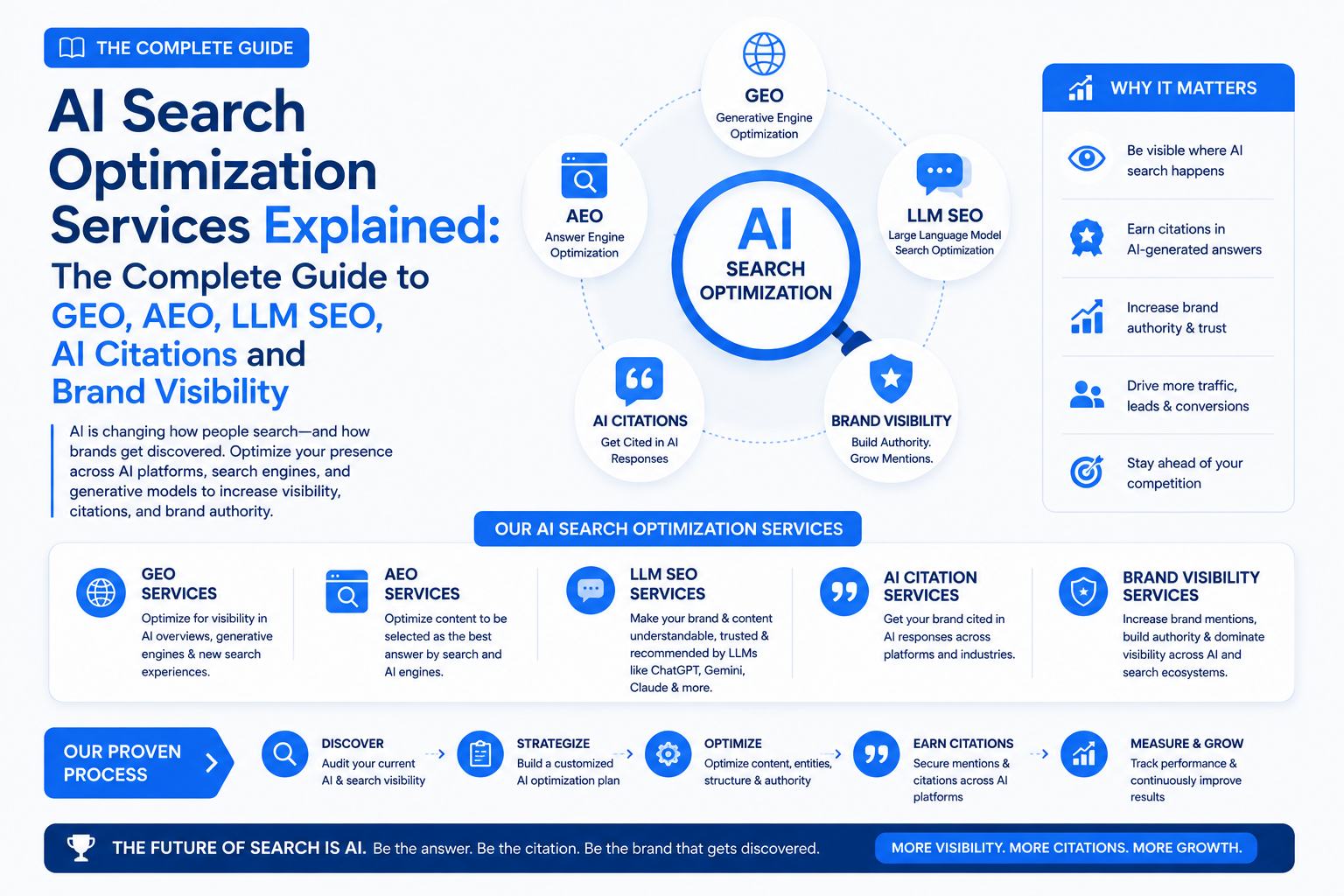
Search Engine Optimization (SEO) improves traditional search discoverability. Answer Engine Optimization (AEO) focuses on content useful to question-answering systems. Generative Engine Optimization (GEO) considers how AI search tools find, interpret, and potentially cite web information. The concepts overlap, and neither guarantees citations.
20.1 Crawlability is a starting point
Access problems such as restrictive robots.txt rules, bot challenges, redirect loops, server errors or TLS issues can limit relevant crawlers’ ability to retrieve content.
20.2 Crawling is not citation
A useful conceptual flow is crawling → processing → indexing or retrieval → relevance selection → AI answer generation → possible citation. Actual systems differ. A page may be crawlable but never selected in an AI answer.
20.3 Content quality remains important
- Original, accurate and current information
- Clear headings and useful explanations
- Descriptive titles and meaningful internal links
- Accessible HTML and working server responses
- Transparent author and editorial details
- Appropriate structured data that matches visible content
- Well-supported comparisons and factual claims
20.4 Structured data is not a shortcut
Valid Article, Product, Organization, and other applicable schema can clarify page information in systems that support them. No universal schema guarantees inclusion in AI-generated responses.
20.5 Measure outcomes, not just crawler visits
Review verified crawler request volume, URLs fetched, errors, AI-related referral traffic, mentions and citations where observable, search impressions and conversions. More bot visits do not necessarily translate into more sales.
21. How to Audit AI Crawlers on Your Website
Phase 1: Review permissions
Download the current robots.txt and identify rules affecting training, AI search, and user-triggered agents. Check broad rules that may unintentionally apply to important sections.
Phase 2: Check accessibility
Test the homepage, key service pages, product pages, articles, and documentation. Inspect HTTP status codes, redirects, and bot challenges. Repeated 403, 429, and 5xx responses can interfere with access.
Phase 3: Analyze crawler activity
Group verified requests by operator and agent. Measure total hits, unique paths, server errors, and request frequency. Focus on high-value pages.
Phase 4: Resolve policy conflicts
A robots.txt allow rule does little good if a security layer blocks the same crawler. Compare published rules with observed server behavior.
Phase 5: Monitor changes
Record policy edits, revisit provider documentation, and periodically inspect server trends. A monthly operational review is a practical starting point for active commercial sites.
22. Common Mistakes in AI Crawler Management
- Treating all AI bots as training crawlers. Search and on-demand fetching serve different purposes.
- Blocking Googlebot to control Gemini training. Google-Extended is a distinct control.
- Using robots.txt to protect private data. Use authentication and server-side security.
- Trusting a user-agent header alone. Spoofing is possible.
- Expecting citations from an allow rule. Crawling does not guarantee selection.
- Ignoring user-triggered fetchers. Some apply different robots.txt behavior.
- Maintaining outdated bot lists. Operators and names change.
- Equating future crawl blocking with removal. Historical copies may persist.
23. Frequently Asked Questions About AI Crawlers
What is the difference between GPTBot and OAI-SearchBot?
GPTBot is associated with possible AI model training data; OAI-SearchBot supports ChatGPT search discovery. They can be controlled separately.
Should I allow OAI-SearchBot?
If ChatGPT Search discovery matters to your website, generally allow access to important public pages. This does not guarantee a citation.
Can I block AI training bots without blocking AI search?
Yes, for operators that publish distinct identities, such as OpenAI, Anthropic, and Mistral. Follow their documented rules.
Does blocking GPTBot remove my site from ChatGPT?
Not necessarily. GPTBot and OAI-SearchBot have different functions, and user-requested retrieval is separate again.
Is Google-Extended an actual crawler?
No. It is a robots.txt control token for specified content uses.
Does blocking Google-Extended affect Google Search?
Google says this control does not affect inclusion in Google Search or ranking.
What is Applebot-Extended?
It is a control token expressing preferences about Apple foundation-model training with Applebot-collected data.
Does PerplexityBot train AI models?
Perplexity says PerplexityBot is for search discovery rather than gathering training content for AI foundation models.
Does robots.txt stop ChatGPT-User?
OpenAI notes that robots.txt may not apply to some user-initiated fetches. Use access controls for private pages.
Can AI crawlers ignore robots.txt?
Some user-triggered systems have different policies, while non-compliant clients can ignore it. Check each provider.
How can I verify a real AI bot?
Use official IP ranges or approved DNS verification, then inspect request behavior. Do not trust user-agent text alone.
What is the difference between CCBot and GPTBot?
CCBot builds Common Crawl datasets; GPTBot collects content for potential OpenAI model training.
Does an AI crawler visit mean my site was cited?
No. A visit shows a request, not indexing, citation, or referral.
Should publishers block all AI bots?
This depends on discoverability goals, licensing and rights. Selective policies often allow more control.
Can AI crawlers access paywalled pages?
Access depends on authentication and implementation. robots.txt alone does not secure paid content.
How often should AI crawler rules be reviewed?
Review when operators update documentation or new agents appear; monitor actual traffic regularly.
24. Official AI Crawler Documentation and Resources
Crawler names, user-agent versions, IP ranges, and access policies can change. Prefer current official operator instructions over undated third-party bot lists.
25. Final Thoughts: Managing AI Crawlers in an AI-Driven Web
AI crawlers perform fundamentally different jobs: training-data collection, search indexing, user-triggered retrieval, advertising checks, and conventional search discovery. Understanding those differences is essential for making sound decisions about access to website content.
A well-managed crawler policy keeps useful public information reachable by the services an organization wants to support while placing appropriate limits on other uses. Combine carefully tested robots.txt rules, verified bot identification, sensible server protections, accessible content, and ongoing monitoring.
The goal is not to allow every bot or block every bot. The goal is to understand what each one does and make a deliberate decision about how your website interacts with it.
0

Leave a Comment